At the General Assembly of the Digital School in Varese, an educational escape room exploring bias, ethics and human responsibility
An algorithm that penalises bright students on the basis of gender stereotypes. An essay containing fabricated bibliographical references. A system that excludes certain candidates from scholarships without providing any explanation. These are the anomalies that teachers will have to identify and correct to complete the mission of “AI in a Trap! An escape room exploring bias, ethics and teaching”, the experiential workshop organised by the Fondazione Mondo Digitale at the tenth edition of the Stati Generali della Scuola Digitale, scheduled to take place in Varese from 12 to 14 November 2026 at the Ville Ponti Conference Centre.
Educating the human. Navigating the digital is the theme chosen for this edition, which brings together teachers, school leaders, researchers, institutions and experts to reflect on the role of schools in the age of artificial intelligence. The Foundation contributes to this reflection with an activity that puts teachers to the test, inviting them to experience first-hand the critical skills they are called upon to develop in their pupils.
A mission to restore human control
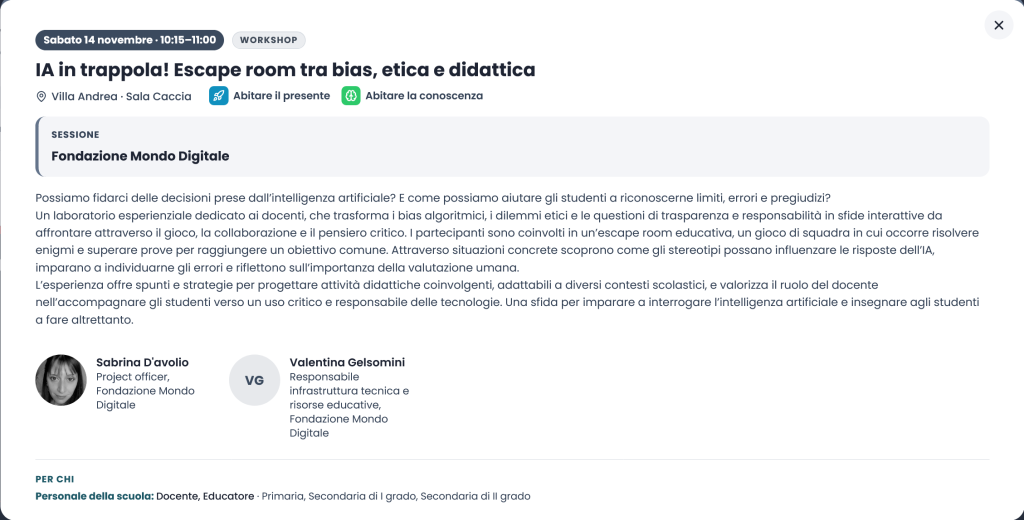
On Saturday 14 November, from 10.15 am to 11 am, in the Sala Caccia at Villa Andrea, trainers Sabrina D’Avolio, project officer, and Valentina Gelsomini, head of technical infrastructure and educational resources at the Fondazione Mondo Digitale, will guide participants through a collaborative race against time. The scenario is that of a school which has entrusted certain assessment processes to A.I.D.A. (v4.2), an artificial intelligence system that produces discriminatory results, unreliable information and decisions that are difficult to interpret. The teachers, acting as an ethics committee, have 35 minutes to analyse the anomalies, solve the puzzles and retrieve the keys needed to activate thehuman override, the procedure that restores control over decisions to people.
The course unfolds across four stations. At the first, participants examine six student profiles to identify possible gender-based discrimination. At the second, they must spot non-existent bibliographical sources within a text generated by AI. The third presents a case study involving the selection process for scholarships, prompting reflection on transparency, explainability and ethical principles. In the final challenge, the teams piece together the clues they have gathered and identify the principle that enables human supervision to be restored. During the game, teachers can also query a Gemini-based conversational terminal, testing their ability to formulate questions, challenge answers and search for information useful for verification. The escape room thus offers a model of active and collaborative learning, adaptable to various educational contexts. Each puzzle provides an opportunity to discuss the errors and limitations of AI systems, exercise critical judgement and understand why decisions affecting people require accountability, oversight and the possibility of challenge.
From an escape room to a community of innovative teachers
Also present at the General Assembly will be Francesca Sabatini, a literature teacher at the Vito Volterra scientific secondary school in Ciampino and coordinator of the second cycle of the Docenti della Scuola del Noi community, promoted by the Fondazione Mondo Digitale.
Her school is one of five selected nationwide as part of the action research project ‘imparIAmo a scuola con l’IA’, promoted by the Centro Studi Impara Digitale in collaboration with the CNR. The awards ceremony is scheduled for Thursday 12 November, whilst Friday 13 November will be dedicated to the presentation of the work carried out by the participating schools. Among the projects developed by the students at Volterra is Socrate Mentor, an AI-based tutor designed to guide learning through questions and prompts, rather than providing solutions directly. It was the students themselves who identified the difficulties they encountered whilst learning, wrote the tutor’s instructions and tested how it worked, even correcting aspects that did not initially function as intended. Originally conceived as an experiment based on the Divine Comedy, the method is gradually being extended to scientific subjects, starting with physics. This experience highlights the value of participatory design and the students’ ability to critically evaluate the tools they use.
The link with the escape room proposed by the Foundation is significant: learning to question AI, recognise its errors and manage its use are skills that cut across both teacher training and the experiments carried out by students.
As Sabatini explained in the column Voices and faces of the teachers at the Scuola del Noi, “my job is not to ban AI, but to guide the pupils in managing it”. This is a perspective that the Fondazione Mondo Digitale is bringing to Varese through practical experiences, in which an understanding of technologies is developed alongside the ability to evaluate, discuss and use them responsibly.
The workshop at a glance
AI in a trap! An escape room exploring bias, ethics and teaching
- When: Saturday 14 November 2026, 10.15–11.00
- Where: Ville Ponti, Villa Andrea, Sala Caccia, Varese
- Organised by: Fondazione Mondo Digitale
- Facilitators: Sabrina D’Avolio and Valentina Gelsomini
- Target audience: teachers and educators from primary schools and lower and upper secondary schools
- Methodology: digital escape room, problem-solving, collaboration and reflection on the ethical principles of AI