AI and architecture are reshaping teaching with PariPasso
Artificial intelligence is making its way into art, technology and architecture classrooms as a tool for observation, research and design. It is at the heart of Beyond the Frame. AI, Design and Architecture, the event held yesterday, 19 October, led by Ilaria La Manna, digital architect, lecturer, researcher and trainer at the Fondazione Mondo Digitale. The webinar forms part of PariPasso, the Rizzoli Education project dedicated to educational inclusion.
The webinar opened with two thought-provoking educational challenges. The first referred to the so-called ‘Gibson trap’, the experiment in which a US lecturer discovered that the majority of students had relied entirely on a chatbot to complete an exam. The second drew attention to the work of Joy Buolamwini at MIT and the concept of the coded gaze, which demonstrated how even facial recognition systems can incorporate the biases present in the data used to train them.
Two very different examples that point to the same educational need: to prevent AI from becoming a cognitive shortcut or an opaque tool. “AI is not just another Google”, as Ilaria La Manna pointed out. We need to learn to question it, verify it and contextualise it, whilst keeping human intelligence, observation and the ability to design at the centre.
Stepping Outside the Frame
This is where the concept Beyond the Frame takes shape. Just as, when looking at a painting, we can imagine what lies beyond the depicted space, so too can a building become the starting point for interpreting the past and designing new possibilities.
The workshop focused on three architectural works belonging to very different eras and styles: the Pantheon, the Palazzo della Civiltà Italiana in the EUR district and Zaha Hadid’s MAXXI. Observation and drawing come before artificial intelligence: geometries, proportions, scales, functions, rhythms, the organisation of space and architectural language are essential for understanding what one subsequently wishes to transform.
And this is precisely one of the most interesting aspects of the method tested during the session: the work does not begin with a prompt.
Once the concept has been sketched on paper, a simple photo uploaded to tools such as Gemini and Krea allows a chain of iterative prompts to be initiated:
- What if the Square Colosseum were to change its function and become a sustainable museum comprising 54 modules covered in grass?
- What if the Pantheon were redesigned with Zaha Hadid’s fluid, futuristic forms, whilst retaining its iconic central oculus?
- What if the MAXXI were reimagined according to the principles of Terragni’s Rationalism?
Live on screen, the lecturers picked up pen and paper, shared their sketches on the virtual noticeboard and began experimenting with their first reinterpretations. AI thus becomes a tool for design research: it helps to compare design languages, explore alternatives, modify functions and materials, and generate scenarios. The quality of the result, however, depends on the user’s ability to formulate an intention, recognise inconsistencies, and progressively correct and refine the design.
Those who were unable to attend can watch the full recording of the webinar and revisit the examples, exercises and experiments proposed by Ilaria La Manna. Watch the recording of Beyond the Frame
From drawing to physical form
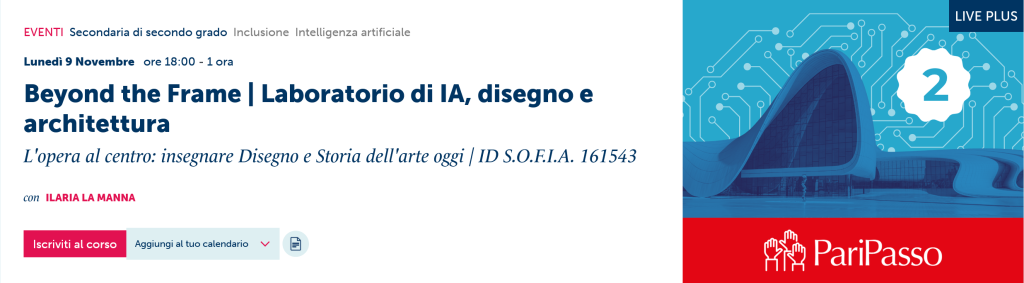
And the journey doesn’t end there. A second workshop on the same theme is scheduled for 9 November at 6.00 pm, dedicated to a further stage in the design process: from image to model and from model to physical form.
The reinterpretations developed using AI can be turned into vector drawings and three-dimensional models, right through to the preparation of files for digital fabrication tools, such as 3D printing, laser cutting and plotters. This is a way to complete the journey that begins with the observation of heritage, moves through drawing and design, and can lead to the actual creation of a prototype.
Discover the programme and sign up for the workshop on 9 November