Knowledge that Connects: Gualtieri’s greeting to the Fondazione Mondo Digitale community
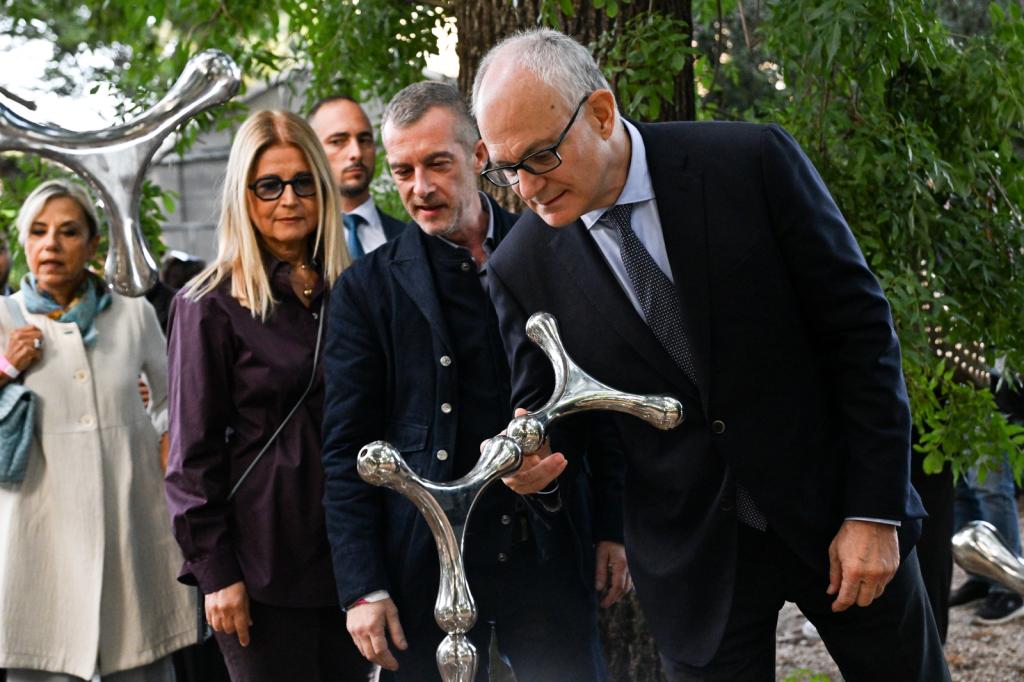
Another weekend of art, research, social innovation and participation with “Knowledge that Connects” and yesterday’s opening, Friday 23 October, of the works by Loris Cecchini at the Rome Botanical Gardens, managed by Sapienza University of Rome. Together with Valentino Catricalà, contemporary art curator and artistic director, the artist guided visitors through an exploration of the project and the research underpinning it.
The afternoon began with an educational session organised by Unidata: as in Milan, Patrizio Pisani, the company’s Director of Innovation and Research, explored the relationships between biological and digital networks, ranging from natural systems and human relationships to the Internet of Things (IoT), from the neural networks of artificial intelligence to cybersecurity. Students from the CMFP in Acilia, accompanied by their cybersecurity teacher Enrico Aleandri, and from the Einstein-Bachelet Higher Education Institute, together with their teacher Mina Luiso, took part with great interest. “We are particularly delighted with this wonderful experience of immersion in art and nature,” commented Luiso. “We would love to collaborate with the Foundation and put our students in touch with experts in innovation and networking,” said Aleandri.
Joining the staff and the many guests from the community in the celebrations was the Mayor of Rome, Roberto Gualtieri, who highlighted the importance of the Foundation’s commitment to an increasingly inclusive and connected Rome, right out to the suburbs. “Congratulations to you all on the important work you have done so far, with an increasingly significant focus on accessibility to the digital world. But thank you also for choosing such a special way to celebrate these 25 years. The Foundation has made works of art and opportunities for shared experiences available to the people of Rome, not just a review of the past 25 years. I believe it is important that this heritage can be revitalised in the face of today’s challenges, from the use of social media to issues such as economic competitiveness, the challenge of innovation in public administration, and our city’s potential to be a creative and strong hub for digital technologies, within the relationship between research, innovation and development. Finally, let us not forget the need for regulation in the digital world and the ethical issues arising from the enormous potential of artificial intelligence. The administration is also committed to reforming administrative processes, because whilst digitalisation speeds up procedures, it also reveals inefficiencies; it is a powerful tool for simplification. Citizens are keen for this! This could be an area for further collaboration between us and the Foundation.”
Following the opening remarks by Renato Brunetti and Mirta Michilli, president and director-general of the Fondazione Mondo Digitale, the director of the Botanical Garden, Prof. Fabio Attorre, thanked the organisation: “As a lecturer at Sapienza University of Rome, I am passionate about raising awareness of the Garden’s commitment to preserving biodiversity.
Bringing an artistic experience such as this to this venue means also introducing people to the culture of conservation. This means fostering connections. When Romans come here, at first they aren’t really interested in its natural heritage, but then they become curious and, in fact, it becomes an open space, a cultural landmark for Rome.”
From around 7.00 pm, the day continued with a convivial gathering, accompanied by food and drink provided by Trapizzino, an innovative, quintessentially Roman street food experience, also known for its selection of wines and craft and organic beers, founded 10 years ago out of Stefano Callegari’s passion.