

Roll Cloud at the University of Milan. Forty university students are working to make MaiSolo AI – the prototype developed at RomeCup 2026 – more secure. The Rivest team wins
From designing an AI-based healthcare service to ensuring its security, taking into account technological, organisational and legal requirements. This was the challenge tackled yesterday, 27 October, by 40 students on the three-year degree course in Systems and Network Security at the University of Milan, who took part in the ‘Secure by design’ challenge, the closing event of the fifth edition of Roll Cloud. Working in the Cloud. The initiative, promoted by the Fondazione Mondo Digitale, forms part of Opening Future, the joint project by Google Cloud, Intesa Sanpaolo and TIM Enterprise.
At the heart of the challenge was MaiSolo AI, the prototype developed by Gabriele Crociani, Alessandro Pasetti and Alessia Castagnedi, students at Roma Tre University, as part of Hack4SocialAI and awarded a prize at RomeCup 2026 [read the news article The future of healthcare is in the hands of young people]. The project envisages a connected care ecosystem that integrates smartwatches, apps for patients and their families, telemedicine and artificial intelligence, with the aim of monitoring the health of vulnerable individuals and providing early detection of potential emergencies.
An idea with high social potential that has become a case study for students at the University of Milan, who have been tasked with identifying potential vulnerabilities, assessing risks and proposing solutions to strengthen the system’s security. How do you protect an app that processes sensitive health data and can contribute to the management of critical situations? And what requirements should guide its development right from the earliest stages?
Under the guidance of Professor Chiara Braghin and other lecturers from the Department of Computer Science, participants worked in teams on challenges relating to software, system and network security, as well as model-driven design, applying the principles of Secure by design.
Following an initial design thinking session led by Fondazione Mondo Digitale trainer Roberta Moretti, the groups developed their own solutions with the support of Giorgio Presepio, a tutor for the Cybersecurity Seminars and an expert in privacy, AI governance and cybersecurity.
“It was a very interesting challenge because I had the opportunity to explain the technical and legal aspects of data protection to the students,” says Presepio. “Design and architectural choices can – indeed, must – be influenced by regulatory compliance.” This is a particularly important aspect in the European context, where the widespread adoption of artificial intelligence requires IT professionals to be increasingly aware of their legal responsibilities as well.
The teams finally presented their proposals to a panel comprising lecturers from the Department of Computer Science, including Professor Pierluigi Perri, who contributed to the assessment from a legal perspective.
The Rivest team takes first place
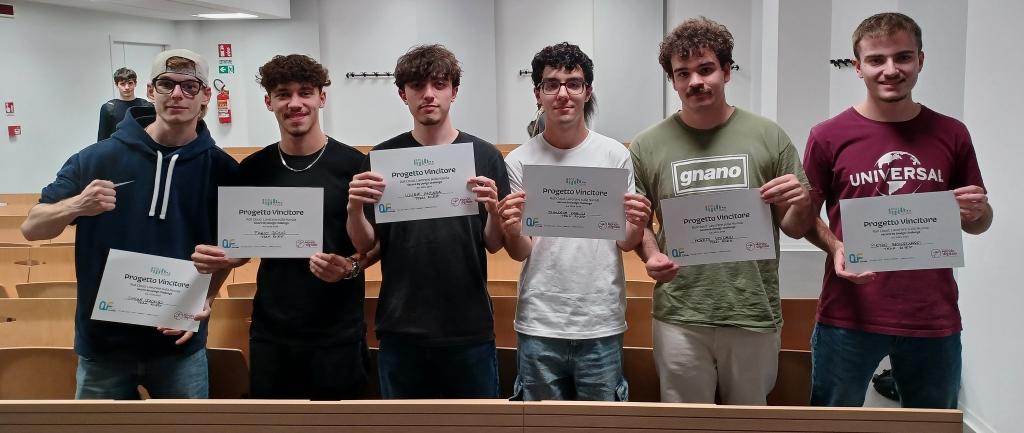
The challenge was won by the Rivest team, comprising Pietro Brandovardi, Emanuele Degiuli, Andrea Lunghi, Vittorio Moretti and Fabio Zolin. The students tackled the complexities of the design within a very tight timeframe, putting their analytical, collaborative and communication skills to the test. “It was a wonderful experience, which allowed us to apply all the knowledge we’ve gained during our studies in Systems and Network Security,” says Andrea Lunghi. “We were able to think things through and use our critical thinking skills to arrive at a very complex solution for a system that was anything but straightforward.”
Alongside technical skills, Andrea particularly emphasises the value of teamwork: “The part I enjoyed most was not only developing all the technical skills, but also working with my teammates, who were crucial in bringing new ideas to life and improving existing ones. I would recommend everyone to take part in this project because it really is an opportunity to put yourself to the test and improve.”
Fabio Zolin, a member of the winning team, also highlights the opportunity to engage with skills different from those typically covered in his university course: “It was a very stimulating experience. I also had the chance to consult with an expert on the regulatory side, given that my course of study has been mainly technical.” Among the most significant lessons learnt, Fabio also mentions the ability to organise work to tight deadlines and the experience of publicly presenting a solution developed together with his teammates.
From RomeCup to Roll Cloud: an ongoing innovation
The challenge brings the fifth edition of Roll Cloud to a close with a concrete example of innovation that grows through the sharing of expertise. A prototype born of the creativity of three young university students during RomeCup becomes a learning opportunity for a further 40 students, who are called upon to tackle a new level of design complexity.
The experience demonstrates just how important it is to integrate technological, legal and organisational skills into the training of future cybersecurity professionals. In particular, when artificial intelligence enters sensitive areas such as health and care, every design choice can have consequences for data protection, the reliability of services and public trust. Security thus becomes an essential aspect of responsible innovation, to be built in from the outset through interdisciplinary dialogue, the ability to anticipate risks and collaborative work.


