Launch of the ‘Il Ponte’ project at the Mahatma Gandhi Comprehensive School
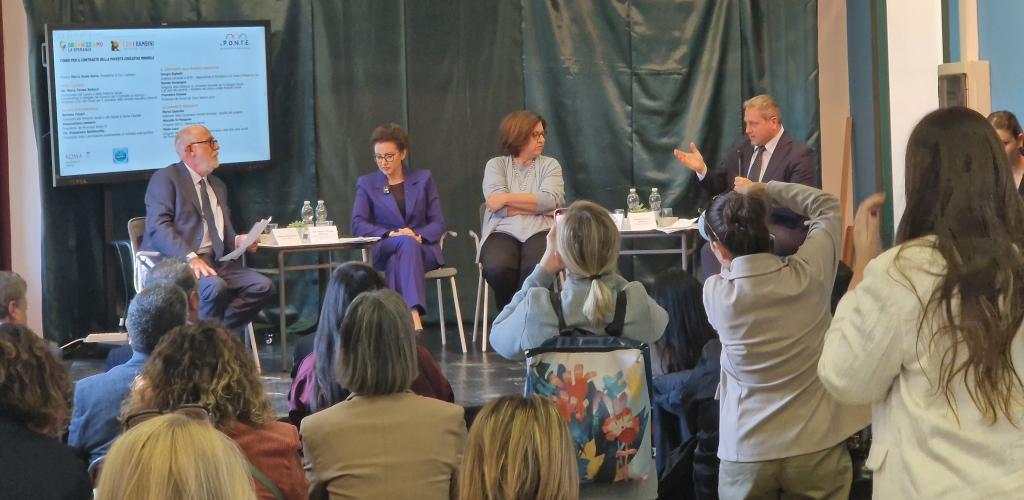
There are few projects in the literature with such a rich and varied partnership: this was the comment that characterised the panel discussion marking the launch of the Il P.O.N.T.E. – Equal Opportunities in Educational Territories project, the result of a strategic alliance between institutions, schools and the third sector to deliver a strong socio-educational programme in the neighbourhoods of San Basilio and Tor Cervara, in Rome’s 4th Municipal District. Yesterday, Thursday 29 October, many of these organisations took part in the presentation held at the Mahatma Gandhi comprehensive school, one of the hubs identified for the initiatives. It was a great celebration, which began with speeches by the organisers and public figures involved in the project and concluded with workshops for children.
The meeting was moderated by Marco Rossi-Doria, president of “Con i bambini”, who commented: “The real novelty of this initiative lies in the involvement of all the active forces in the local community, without exception. It is a truly collaborative project, and over the next four years we will have much to learn from the interaction between these different organisations”. Hon. Maria Teresa Bellucci, Deputy Minister for Labour and Social Policies, then took the floor: “Starting with the name of the initiative, ‘Let’s Organise Hope’, we’ve rolled up our sleeves to make the most of the available funds, without wasting a thing. Hope cannot spring from optimism alone, but from what we might call the ‘builders’ – people willing to lay the foundations, getting their hands dirty. It is from this process that community spaces for young people emerge: we are opening the school doors even outside normal hours to meet people’s needs.” The commitment of Roma Capitale and local organisations was highlighted by the Councillor for Social Policies and Health of Roma Capitale, Barbara Funari: “The synergy between institutions and the third sector creates new spaces for dialogue amongst young people, bringing this part of the city to the fore. The presence of 35 organisations around one table is further proof that Rome is ready to collaborate in order to grow.” Massimiliano Umberti, President of Rome’s 4th Municipal District, echoed this sentiment: “We are undertaking something truly unprecedented for the neighbourhood: building the future of our citizens at breakneck speed! We must enable people to keep pace, so that San Basilio is not only known for its public safety issues, but also for the energy that drives it, and for the residents who are fighting to provide opportunities for their children”.
Hon. Alessandro Battilocchio, chair of the Parliamentary Commission of Inquiry into the Suburbs, noted that this is “a period of revitalisation from north to south, thanks in part to the opportunity to propose major projects. There is now a growing realisation that the gap between city centres and the suburbs must be bridged. This is a time for renewal, but we must ensure continuity of action and sustainability in the projects undertaken, with the involvement of local communities”. Giorgio Righetti, Director-General of Acri, provided a detailed overview of his organisation’s funding and governance model: “We have decided to devote resources and energy to combating educational poverty. However, these are not sufficient on their own.
Our model has stood the test of time because it involves government representatives, foundations and savings banks, as well as third-sector organisations, which provide us with the expertise to identify needs and organise interventions.” Francesca Danese, spokesperson for the Lazio Third Sector Forum, emphasised the value of the local social fabric: “There have been many changes in the municipality in recent years, and just as many organisations have come and gone in the area. The community, however, remains strong and possesses a wealth of skills: this project goes beyond individualism and promotes the growth of everyone involved.”
Il Ponte is led by the Antropos social cooperative as the lead organisation. Marco Caporale, the cooperative’s representative, explained: “As the lead organisation, we have overseen the co-design process with all those involved. The seven schools cover the entire school cycle and contribute their commitment alongside the other partners and the borough council. The aim is to leverage schools as the cornerstone of the educational community and a resource for the local area. Working together with teachers and educators is therefore essential”. School heads in the area emphasised the importance of integrating formal and informal education. Marcello Di Pasquale, headteacher of the Mahatma Gandhi school, highlighted how San Basilio has sought renewal and growth through cultural initiatives, such as street art, and how informal education has proved to be just as important as formal education. “Today, families find it difficult to collaborate with the school for the well-being of their children: it is precisely this connection that we are seeking.” Finally, Paolo Lozzi, headteacher of the Ennio Morricone Comprehensive School and coordinator of the Rome IV Municipal District School Network, concluded: “Those who choose San Basilio do not do so by chance. The community education pact is an alliance between stakeholders sharing a common vision, with schools open to the local community thanks to third-sector organisations, in full collaboration with local authorities and families, who are often the weakest link. The school does a very strong job, but it cannot do it alone! Skills must be shared and exchanged. Furthermore, we must be open to listening to those in front of us, combating the sense of loneliness felt by our young people”.
The morning concluded with a ribbon-cutting ceremony and a tour of the school premises dedicated to the project, followed in the afternoon by hands-on workshops and activities for children. In particular, Marco Brocchieri and Valentina Gelsomini from the Fondazione Mondo Digitale led a creative coding activity designed to develop problem-solving skills.
 This report is by Onelia Onorati, press officer at the Fondazione Mondo Digitale.