
Artificial intelligence and robotics safeguarding our ecosystems
With the arrival of summer and the return of millions of people to the coast, harbours and lakesides, the challenge of protecting aquatic ecosystems becomes even more apparent. It is precisely here that the RomeCup 2026 reveals one of its most practical aspects: that of technology which does not remain confined to laboratories, but tackles real-world problems such as pollution, environmental monitoring, the safety of bathers and the protection of biodiversity.
In the MareBOT category, students, supported by universities and research centres, have designed solutions that combine robotics, sensor technology and artificial intelligence to observe, prevent, collect data and take action. The result is a vision of innovation closely tied to local areas and the needs of communities, capable of viewing the sea not only as a natural space to be protected, but also as an environment to be better understood – in a continuous, accessible and sustainable way.
Let’s take a look at the seven projects in the MareBOT category, born out of collaboration between schools and universities:
1. Swimmer safety and coastal monitoring
The Gian Domenico Cassini secondary school in Sanremo (Imperia), in collaboration with the PoliTocean team from the Turin Polytechnic, presented Meducamera. This is a watertight device designed to detect and recognise the presence of jellyfish in real time using AI (Gemma by Gemini). The system includes the Medusometro, a digital display on the beach that indicates whether the sea is safe for swimming, and also features a text-to-speech synthesiser for visually impaired bathers.
2. Analysis of inland water quality
The Bertrand Russell High School in Cles (Trento), supported by the Campus Bio-Medico University in Rome, has developed AcquaScanner. This prototype, created entirely using 3D printing, is a ‘little boat’ equipped with sensors to monitor pH, dissolved oxygen and turbidity. It is specifically designed for ponds and marshes where constant monitoring of aquatic biodiversity is required.
3. Autonomous sentinels against illegal fishing
The Enrico Fermi Technical and Industrial Institute in Rome, together with the University of Pisa, has proposed Infinity, a marine drone designed as an autonomous sentinel for protected areas. With a trimaran configuration and solar-powered propulsion, the drone is capable of monitoring biodiversity and detecting illegal activities such as poaching or unauthorised anchoring.
4. From detection to waste collection
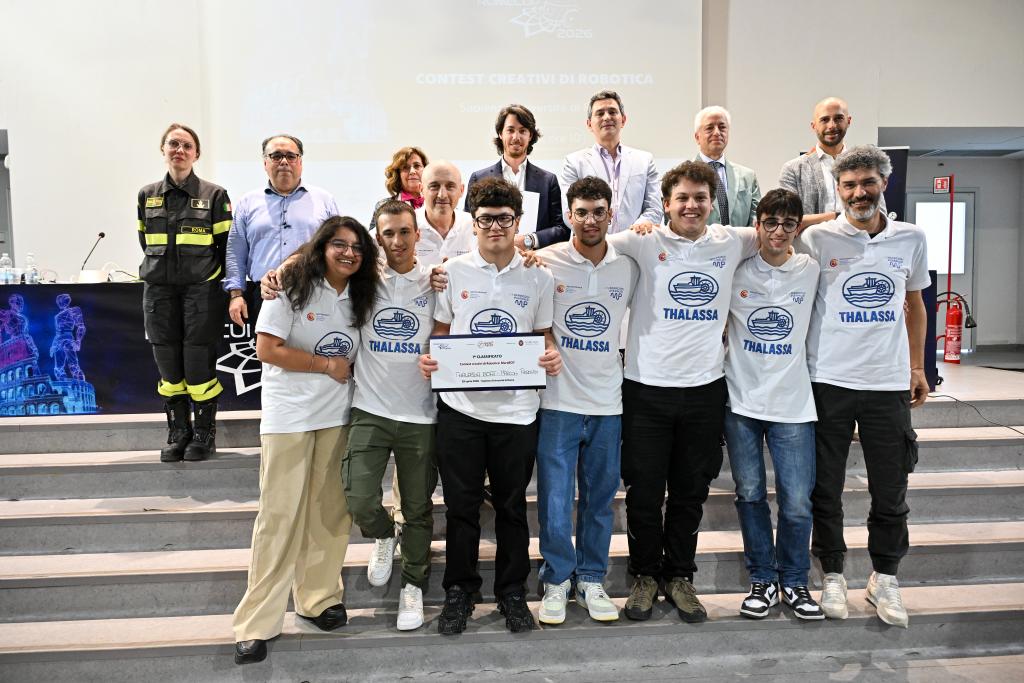
The Marconi Pieralisi Institute in Jesi (Ancona), in collaboration with the Polytechnic University of the Marche, has transformed the previous Calypso robot into the new Thalassa. This radio-controlled catamaran not only identifies floating waste in the Adriatic using AI, but is also equipped with a mechanical rotating drum system capable of physically collecting it to clean up the sea surface.
5. Monitoring the health of the Mediterranean
The Guglielmo Marconi Institute in Nocera Inferiore (Salerno), together with the University of Florence, has developed the Marconi Rov Explorer (MRE). This underwater rover focuses on monitoring Posidonia oceanica, an endemic plant that serves as a key bioindicator of the sea’s health.
The system uses computer vision (Roboflow platform) to detect the presence of microplastics as well.
6. Listening to the giants of the sea
The Panella Vallauri Institute in Reggio Calabria, in collaboration with the Turin Polytechnic, has presented EcoWhale. The project consists of a marine drone for bioacoustic monitoring in the Strait of Messina. Thanks to sensors calibrated to infrasound (20 Hz), the unit detects the ‘song’ of cetaceans to alert shipping traffic in real time and prevent fatal collisions, drawing inspiration from the story of the whale ‘Codamozza’.
7. A network of low-cost smart buoys
The Vito Volterra Scientific High School in Ciampino (Rome), together with the University of Pisa, has developed the Volterra Blue Sentinel (VBS). This is an extremely cost-effective smart buoy (estimated cost of around 35 euros) that uses recycled materials such as swimming pool tubes and airtight containers. The VBS monitors a range of parameters, including wind speed, wave height and turbidity, sending the data to a web interface to create a widespread environmental monitoring network.
These projects demonstrate how RomeCup is much more than just a competition: it is a laboratory where young people learn to design useful, sustainable technologies rooted in reality. In the case of MareBOT, the sea thus becomes a space for learning and innovation, to be observed, protected and inhabited with greater responsibility.