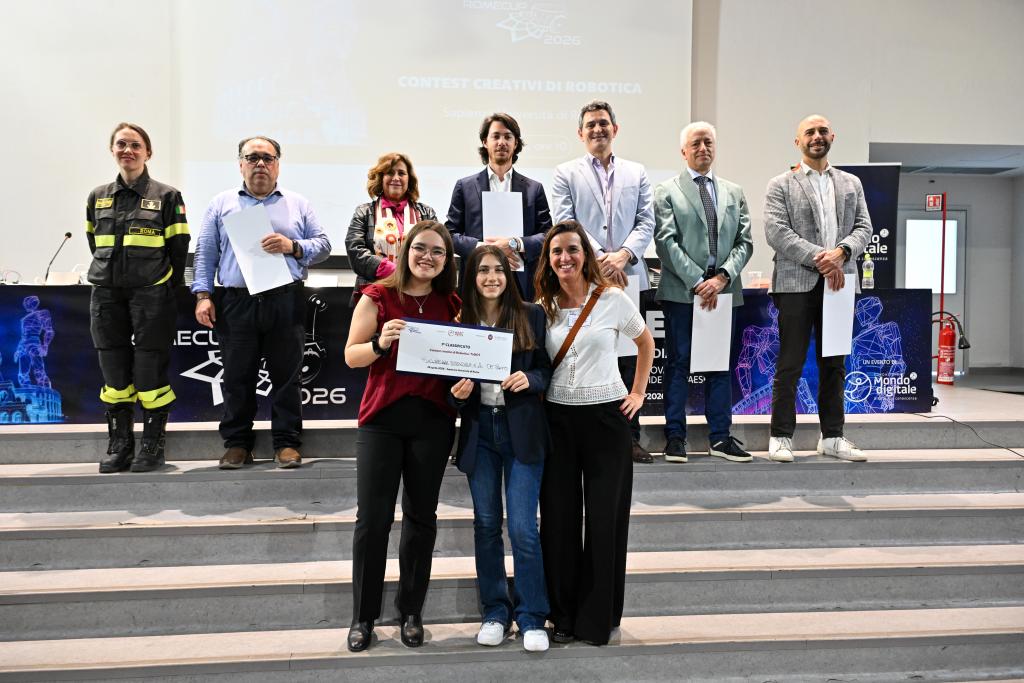

RomeCup 2026: three projects to prevent accidents and speed up emergency response
With summer comes the return of holiday departures, busy motorways and long journeys to holiday destinations. And with them comes a crucial question: how can we make travel safer, especially at times when human error, a delay in emergency response or extreme conditions can mean the difference between life and death? At the RomeCup 2026, the TirBOT category seeks to address precisely this challenge, focusing on technology that does not seek to create a spectacle, but rather on prevention, timely intervention and the protection of people [read the article Robotics that meets real needs].
The three projects presented by the students tackle three crucial aspects of safety: preventing those who are unfit to drive from getting behind the wheel, reducing waiting times following an accident, and intervening swiftly in critical scenarios such as those in mountainous areas. What emerges is a very practical vision of innovation: artificial intelligence, sensor technology and robotics not as an abstract exercise, but as tools serving everyday life.
1. Active prevention: AI against drink-driving
The team from the Gaetano De Sanctis High School in Rome, in collaboration with Roma Tre University, has developed a system that tackles one of the most serious causes of road accidents: driving whilst under the influence.
The project is based on a model created using Google Teachable Machine, with which the students trained a visual recognition system capable of distinguishing between sober people and those under the influence of alcohol. They combined this software component with a smart circuit based on Arduino and Tinkercad, designed to trigger an automatic alarm. The vision for the project’s future development is clear: to integrate facial recognition systems directly into vehicles, so as to prevent the car from starting when the driver is unfit to drive. It is a project that stands out for its simplicity and immediacy: preventing an accident before it even happens.
2. Prompt emergency response: the RIA project
The Teresa Gullace Talotta High School in Rome, also supported by Roma Tre University, has chosen to focus on the moment immediately following the impact, when every second lost can exacerbate the consequences of the accident. The R.I.A. project, an acronym for Car Accident Detector, was conceived with a very specific aim: to eliminate the delay between the accident and the arrival of the emergency services, especially when the person involved is alone, injured or unable to call for help. The prototype consists of a miniature device equipped with a microcontroller and an accelerometer, capable of detecting the impact and interpreting the data in real time using a specialised algorithm.
The team is already envisaging some very promising developments: the integration of GPS modules for immediate location tracking, LoRa systems to enable communication even without an internet connection, cameras to transmit images of the scene, and automatic analysis using artificial intelligence to assess the severity of the accident. It is a project that shifts the focus from ‘after the event’ to ‘immediately’, and which demonstrates just how integral timeliness is to safety.
3. Safety in extreme conditions: ARS
With ARS – Avalanche Rescue System, the technical institute Panella Vallauri in Reggio Calabria, in collaboration with Sapienza University of Rome, extends the concept of road safety to mountainous environments, where danger stems not only from traffic but also from the natural environment.
The starting point is strikingly simple: in avalanches, time is of the essence. For this reason, the students have designed an autonomous tracked rover capable of moving over snow and debris and quickly locating any victims thanks to an AMG8833 thermal imaging camera, which can detect human body heat in real time even in extreme conditions.
The value of the project lies in the combination of autonomy, operational continuity and reduced risk for human rescuers. The rover can, in fact, operate continuously, intervening where speed of response is everything and where it may be impossible for a person to enter the scene safely straight away.
Technologies that protect
Taken together, the three projects in the TirBOT category clearly illustrate one of RomeCup’s key insights: robotics and artificial intelligence truly come into their own when applied to concrete problems and real-world needs. In this case, the young participants did not envisage technologies detached from everyday life, but rather tools capable of making journeys safer, rescue operations faster and emergency responses more effective.
This is what makes TirBOT a particularly relevant category: whilst millions of people travel for work, holidays or out of necessity, the young people at RomeCup are designing a future in which the road is not just a place of risk, but also a space where innovation can save lives.