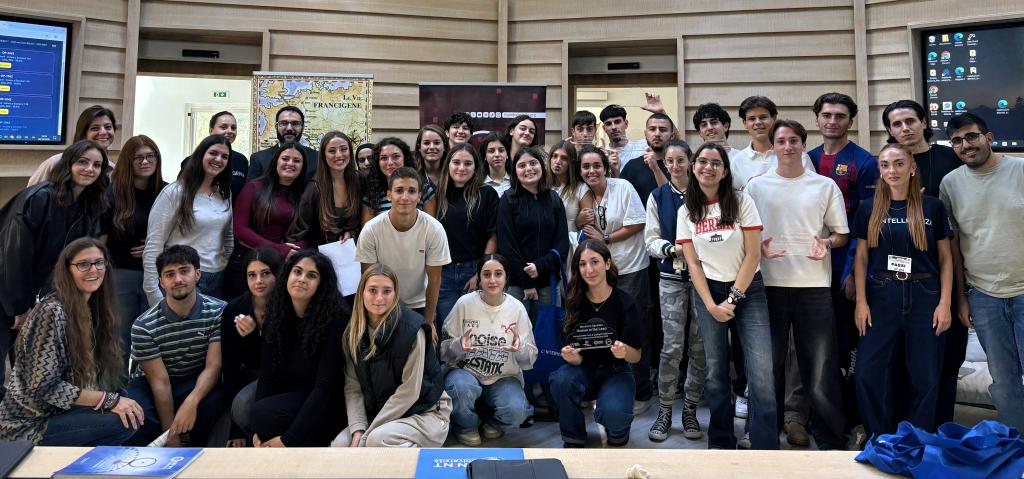

Coding Girls & Women: a hackathon in collaboration with UNINT
How can digital technologies be used to make agriculture more sustainable? This was the question that sparked the initiative by students at the Emilio Sereni Agricultural Technical College in Rome, who took part in We Code, the hackathon organised as part of the Third Mission activities of theUniversity of International Studies in Rome (Unint) and in collaboration with the national programme Coding Girls & Women, supported by the Ministry of Labour and Social Policies (Call for Proposals 2/2024) [see the news article We Code: learning AI by doing].
The event on 8 October involved 28 students from the fourth and fifth years, who were asked to work in teams to develop ideas and solutions related to the agri-food sector. It was an opportunity to experiment with artificial intelligence, put the skills acquired at school into practice and engage with the opportunities and responsibilities presented by new technologies.
From idea to project: six teams for more sustainable agriculture
From 8.30 am to 4.30 pm, six teams worked on designing their own solutions, supported by university tutors from Unint’s ‘Unintelligenza’ community. The experience was made even more interactive by the presence of the humanoid robot Nao, who was on hand to answer the groups’ questions.
The challenges covered a range of topics, from the reuse of agricultural waste to the protection of biodiversity, from water resource management to workplace safety.
Among the projects presented, three received a special mention:
- Originality. Uva Rinata. A platform to connect wine-producing estates and encourage the reuse of must waste, promoting a circular economy model.
- Human in the lead. Via Verde. An app for viewing interactive maps of parks, even without an internet connection.
- Presentation. Terre Sereni. A portal to promote the school’s produce and farm, showcasing the institution’s skills and activities through a digital showcase.
The other groups worked on biodiversity protection and soil conservation (MII), renewable energy and water management in greenhouses (AgriWater), and safety in agricultural workplaces (Averto). What united the various proposals was the opportunity to tackle real-world problems through collaborative design, exploring how technology can help find solutions without losing sight of people. This is the meaning behind ‘human in the lead’, the principle that guided the experience.
The school as a laboratory for innovation
For the Emilio Sereni Institute, the hackathon forms part of a programme aimed at integrating digital skills into students’ education, linking them to their chosen fields of study and to changes in the world of work.
“Today we are here with the Fondazione Mondo Digitale to organise a major hackathon initiative for our students – an initiative that forms part of our educational vision to create a digital hub within the school and to foster knowledge and the critical, informed use of digital tools and artificial intelligence,” explains Michele Zannini, headteacher of the school.
The programme will continue with a further six educational workshops funded by the National Recovery and Resilience Plan (PNRR) (Ministerial Decree 219/2025), dedicated, amongst other areas, to the use of educational headsets, hydroponic greenhouses, and regional development and employability.
In fact, technological skills are becoming increasingly important in the agricultural sector too.
“Today, agriculture is no longer just about working the land by hand; it also involves planning, implementing specific projects and utilising technology and artificial intelligence,” emphasises Giuseppe Altobelli, agronomist and deputy headteacher of the school. “The pupils can learn these concepts first in the classroom and then apply them directly in the world of work, to make their future activities simpler and more effective.”
For Arianna Massimi, a science teacher and the initiative’s coordinator, the value of the day also lies in the opportunity to experiment together: “We are here with the Year 4 pupils to introduce them to artificial intelligence and, above all, to get them working together on projects that allow them to use it for positive purposes, linked to their course of study”.
When an experience leaves its mark
The hackathon also offered a glimpse into the lasting value that educational experiences can have. Among those present was Lori, a universal civil service volunteer at the Fondazione Mondo Digitale, who, as a student, had taken part in one of the Foundation’s events, and it was on that very occasion that she first became interested in computer science. “When I was at secondary school, I took part in an event organised by the Fondazione Mondo Digitale and became so passionate about computer science that I went on to choose it as my university course, because they had given me a completely new perspective. Today, for the first time, I find myself on the other side, looking behind the scenes of a project like this and seeing its impact on the young people.”
For Eleonora too – who is also a universal civil service volunteer in the Foundation’s communications department – taking part in the event was an opportunity to observe the groups’ work at close quarters. “It was truly inspiring to see the commitment and enthusiasm with which the young people tackled the challenges set, presenting some really sound and innovative ideas. Reflecting on this experience, I think about how much I would have loved to have had a similar opportunity at their age, and I believe that initiatives of this kind offer young people a valuable chance to put themselves to the test.”