
RomeCup 2026: the ‘Aura’ project from the Avogadro High School in Vercelli wins the Cobot creative contest
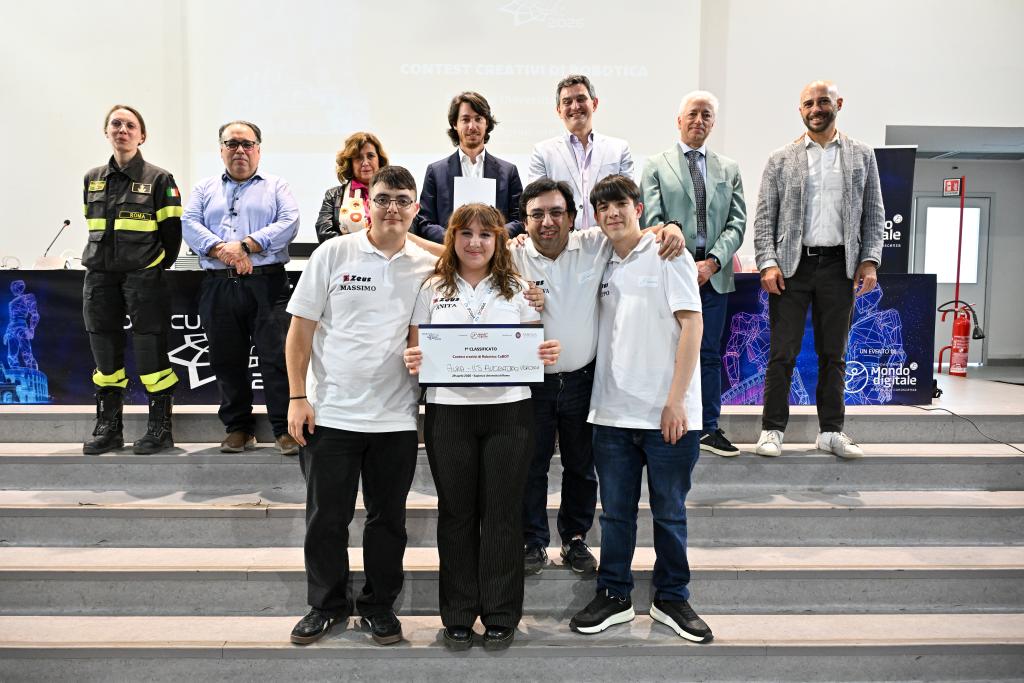
For the third time in four years, the Amedeo Avogadro High School in Vercelli has taken the top spot on the podium in the Cobot category, dedicated to collaborative robotics. At RomeCup 2026, the team comprising Anita Portafoglio, Filippo Ferrara and Massimo Nigra, under the guidance of teachers Lucetta Bertinetti and Luca Oliva and with the support of the University of Eastern Piedmont, took first place with A.U.R.A. Assistive Unit for Rehabilitation and Autonomy.
The project proposes a rehabilitation exoskeleton designed to support the movements of arms, hands and fingers and assist patients or elderly people with mobility difficulties. A solution created to support the therapeutic process and, above all, to envisage more accessible rehabilitation even outside clinical settings, in domestic and everyday contexts.
‘A.U.R.A. is a project involving a rehabilitation exoskeleton that is highly immersive for both the user and the patient,’ explains Anita Portafoglio in the video testimonial filmed during the RomeCup. ‘Its aim is to support medical care for those with mobility difficulties and to help people who, in the future, due to minor injuries or old age, will need support with movement even at home.’
The prototype has been designed to act on the shoulder, elbow, wrist and fingers, with various modes of use. The first mode uses a graphical interface developed by the students in C#, connected to an Arduino Nano board via a serial port. From here, the user can activate pre-programmed movements, such as opening and closing the hand or moving one finger at a time, or create customised sequences together with a doctor, physiotherapist or physiatrist, and then replicate them during exercises at home.
There is also a manual mode, which allows the various parts of the exoskeleton to be moved progressively, one degree at a time, and a mode based on touch sensors: the patient interacts with the sensor and, depending on the duration of contact, activates specific hand movements. The different modes can be used together, in a complementary way, to adapt the device to the individual’s needs.
A.U.R.A. integrates mechanical and digital components: an Arduino board, touch sensors, high-torque servomotors, materials such as PETG, PLA, Teflon and aluminium, as well as a user-friendly app designed to assist the user and monitor rehabilitation progress. In the project documentation, the students also highlight the prototype’s modularity, which can be improved, optimised and potentially adapted for use on other parts of the body.
The recognition received at RomeCup confirms the quality of the collaboration between school and university. The IIS Avogadro, which comprises the Liceo Avogadro in Vercelli and the ITIS G. Galilei in Santhià, worked in close collaboration with the University of Eastern Piedmont, with technical and scientific input from Professor Massimo Canonico. An educational ecosystem that allows students to tackle complex problems, design practical solutions and understand how robotics can serve people.
‘A.U.R.A. perfectly illustrates the spirit of RomeCup’s creative contests: we don’t ask the students to imagine abstract robots, but solutions capable of engaging with real life,’ emphasises Eleonora Curatola, who coordinated the creative robotics contests. ‘In this case, collaborative robotics enters the field of rehabilitation and personal autonomy, an area where technology can only make a difference if it remains closely attuned to people’s needs. The team has successfully combined technical expertise, social awareness and a practical vision of development.’
With A.U.R.A., the Cobot category of the RomeCup 2026 showcases a form of robotics that does not replace, but accompanies; does not merely automate, but supports; does not work in place of humans, but alongside them, to restore movement, confidence and independence.