
From 15 to 25 October, a programme of talks, artworks, tours and workshops to share the journey of the Fondazione Mondo Digitale and look to the future
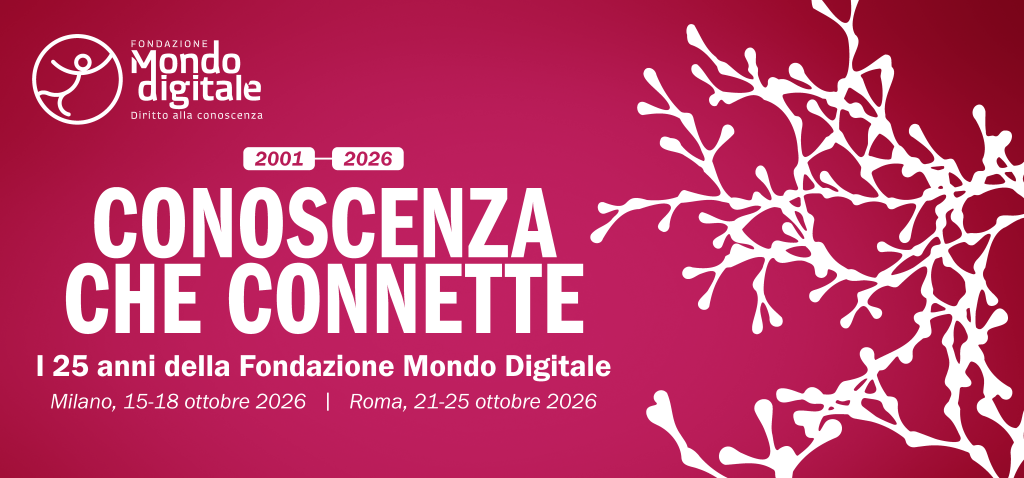
Two cities, two botanical gardens, four categories of contemporary artworks and a programme involving universities, schools, institutions, businesses, social organisations and members of the public. Thursday 15 October in Milan sees the launch of Knowledge that Connects, the artistic and cultural project marking the 25th anniversary of the Fondazione Mondo Digitale ETS. Following four days in the Lombard capital, the initiatives will continue in Rome, from 21 to 25 October, with a conference dedicated to the social economy in the digital age, art installations, talks, guided tours, workshops and a celebration together with the Foundation’s communities.
The project stems from a collaboration with University of Milan, Brera Academy of Fine Arts and Sapienza University of Rome. It is a co-design initiative that links the university’s third mission, research and artistic experimentation with social innovation. Unidata is also taking part, with volunteer expertise from its professionals in activities aimed at schools.
The Shape of Relationships
At the heart of Knowledge that Connects are the works of Loris Cecchini, an Italian artist of international renown, curated by Valentino Catricalà. His modular structures explore the principles through which simple elements connect, interact and generate complex forms. Waterbones, Sequential Interactions in Alfalfa Chorus, Arborexence and Airborne develop four modes of relationship: connection, cooperation, branching and propagation. Situated in the Brera and Rome Botanical Gardens, the sculptures enter into dialogue with trees, plants and landscapes, offering new perspectives on the processes of organisation and transformation in nature.
It also reflects the social impact the Foundation seeks to generate: expertise that is shared, a relationship that creates new opportunities, and an educational experience that spreads to other contexts [read When art makes social impact visible].
Milan, 15–18 October: art, academia and citizenship
The programme begins on Thursday 15 October at 5.00 pm at theBrera Botanical Garden, with the unveiling of the works and a discussion on the cultural value of the project featuring the artist, the curator and academics from the University of Milan and the Brera Academy. In the evening, in the former church of San Carpoforo, an event dedicated to the Foundation’s history will feature a preview of the 25th-anniversary book and the documentary Il futuro per tutti, directed by Francesco Faralli.
Friday 16 October is the day dedicated to universities and schools, with guided tours and in-depth activities. Saturday 17 October sees the programme open to the general public, whilst Sunday 18 October is dedicated to families, with tours and workshops.
Rome, 21–25 October: from the social economy to communities
The second part of the programme begins on Wednesday 21 October, from 3.00 pm, at the Sala Baldini in Rome, with the conference The Impact of Digital Technology on the Social Economy, organised in collaboration with the Terzjus Foundation. The event brings together representatives from institutions, experts and third sector organisations to explore the role of digital transformation and artificial intelligence in the implementation of the National Plan for the Social Economy. At the heart of the discussion is the Charter for the Inclusive Digital Transformation of the Social Economy, which sets out proposals for public decision-makers. The conference will also feature the presentation of the results of a study on the digital transition of the Italian Red Cross, carried out on a longitudinal sample of 716 volunteers and staff: the overall digital skills index shows a 29 per cent increase, rising to 43 per cent in the areas of problem-solving and artificial intelligence.
The day continues with a private, invitation-only institutional reception at Villa Pinciana, hosted by the Deputy Chief of Mission at the Embassy of the United States of America.
Friday 23 October, at 5.00 pm, the Rome Botanical Garden, managed by Sapienza University of Rome, will host the opening of an exhibition of works by Loris Cecchini, attended by the artist and the curator, along with a further presentation of the book and documentary dedicated to the anniversary.
Saturday 24 and Sunday 25 October the events will be open to families and the general public. Alongside guided tours of the Botanical Gardens, there will be workshops at the Palestra dell’Innovazione, at 102 Via del Quadraro, aimed at children, teenagers and adults, covering digital fabrication, robotics and creativity [read the news article Knowledge that connects: open workshops].
Also scheduled for Saturday 24 October is the 25th-anniversary celebration with the Foundation’s communities, an opportunity to reconnect with students, teachers, families, volunteers, partners and everyone who has helped shape this story.
Twenty-five years told by the people
The Foundation was established in 2001 as the Consorzio Gioventù Digitale, chaired by the linguist Tullio De Mauro and with the scientific input of Alfonso Molina, co-founder and now scientific director. From digital literacy to intergenerational programmes, from the ‘Palestre dell’Innovazione’ to digital citizenship and artificial intelligence, the Foundation’s journey has evolved around a single mission: to build a democratic knowledge society.
The 2025 Social Report sets out the current scale of this work: 195,431 people involved, 50,396 students and young people on training courses, a community of 800 schools, 75 universities and research centres, 161 partners and 57 active projects.
Alongside the figures are people’s stories. Such as Simone, who discovered new possibilities through a communication workshop; Rosella, a key figure in intergenerational learning; and Emanuele, who was introduced to robotics as a child and now helps to teach it.
These experiences are the subject of the book Quel millimetro nel futuro, due to be published shortly by FrancoAngeli, and the documentary Il futuro per tutti, which look back over twenty-five years through testimonies, memories and images.
Another perspective on the Foundation’s history comes from the autobiographical book by Alfonso Molina, La lotta e altre due o tre cose sulla felicità, published by FrancoAngeli: from Salvador Allende’s Chile to exile, from his academic career in Edinburgh to research into socio-technical innovation and the founding of the Fondazione Mondo Digitale [see the news item La lotta per la felicità].
I’m in! Let’s turn connections into relationships
The anniversary also marks the launch of I’m in!, the Fondazione Mondo Digitale’s first fundraising campaign, hosted on Rete del Dono.
After twenty-five years of partnerships with schools, institutions, universities and businesses, the Foundation is opening up a new opportunity for direct participation to citizens, families, teachers, students and volunteers. Stories of impact accompany the invitation to support new educational and inclusion opportunities. The question at the heart of the campaign is simple: “Will you join us too?”
How to take part
The opening ceremonies, institutional meetings and the conference on 21 October are by invitation only. Guided tours, workshops and activities open to the public are free of charge, subject to booking. To find out about the programme and how to take part: