
Three female students bring young women’s expectations to the stage at ‘The Economy of the Future’. A discussion that ties in with Coding Girls & Women’s commitment to a professional future free from stereotypes
“Above all, from a woman’s perspective, I hope there will be a change.” Alessia Buscolini, an Ecodesign student at Artwood Academy, envisages 2036 as a world where it is easier to build one’s own future, balance work and private life, and realise one’s aspirations. She views the short working week and remote working with interest, but above all calls for an end to the injustices that still penalise women. Because, she emphasises, “ignorance does not lead to change”.
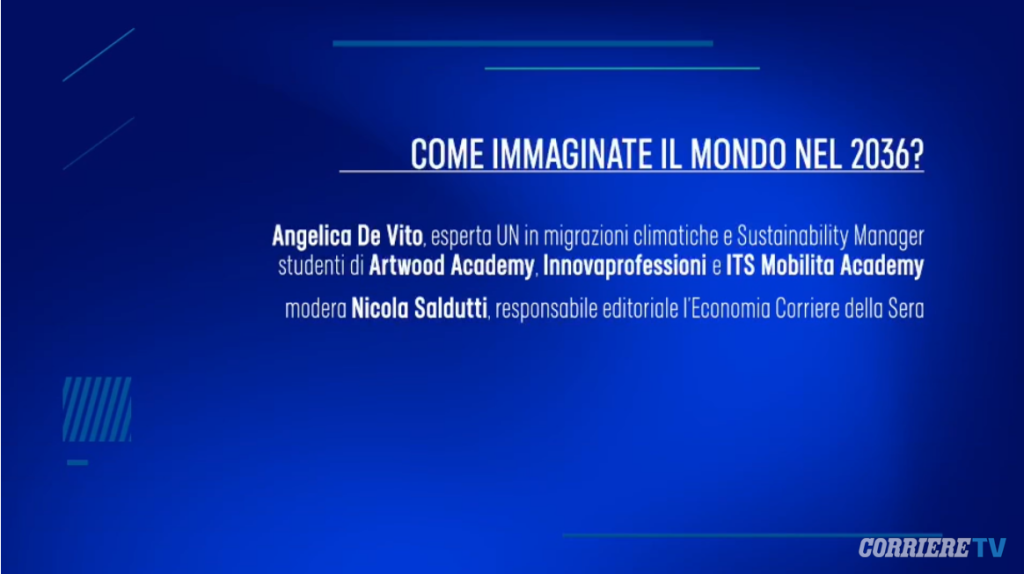
Her reflection is one of the testimonies that emerged at Generation 2036, the session dedicated to young people as part of The Economy of the Future, the event organised by Corriere della Sera on 19 November at the Triennale di Milano [see the news item Generation 2036: “Don’t let them steal your future”].
The Fondazione Mondo Digitale, the event’s knowledge partner, involved over 120 students from Artwood Academy, Mobilita ITS Academy and Innovaprofessioni ITS Academy, guiding them through a preparatory programme organised by Sabrina D’Avolio, project officer and trainer at the Foundation. This training experience was designed for the entire group, enabling the twelve students who took to the stage to share their ideas with the audience, whilst allowing the other participants to follow the debate with a deeper understanding and greater capacity for reflection. Among the perspectives on artificial intelligence, robotics and sustainability, gender equality emerged as a concrete priority, linked to employment opportunities, economic independence and the freedom to choose one’s own life path.
A right enshrined in 1948, yet still to be realised
It was Vittoria Brambilla, also an Ecodesign student at Artwood Academy, who highlighted with particular clarity two obstacles that continue to shape women’s professional lives: the pay gap and the difficulty of balancing motherhood and a career. “Often, even though we have the same responsibilities as men within companies, we are paid significantly less,” observes Vittoria, also highlighting the fact that motherhood is still regarded as incompatible with career progression. Her account prompts an immediate response from Nicola Saldutti, editorial director of L’Economia del Corriere della Sera, who refers to Article 37 of the Italian Constitution, which has been in force since 1 January 1948. Almost eighty years ago, the Republic recognised women’s right to equal treatment and equal pay for equal work. Yet, as Saldutti observes, the younger generations still have to envisage the full recognition of these rights as a goal to be achieved by 2036. This reference takes on particular significance because it shifts the responsibility from the young women calling for change to the adults who should already have brought it about. The gap between constitutional principles and the actual conditions of women’s work thus becomes an intergenerational issue.
Claudia Don Manuwellage Vihange, a student of Sustainable Intermodal Logistics at the Mobilità ITS Academy, also includes equal pay in her vision for the future. She envisages a more innovative and sustainable transport sector, but hopes that by 2036 women will be able to receive the same pay as men and that this principle will finally be put into practice.
Three testimonies which, whilst stemming from different educational backgrounds, converge on a specific demand: to be able to enter the world of work without encountering gender-related barriers, with the opportunity to grow professionally and plan their own lives.
Work must enable us to live
In the students’ own words, equality also concerns quality of life. Alessia Buscolini calls for a way of organising work that leaves more room for wellbeing, relationships and personal plans. She does not necessarily expect radical changes over the next ten years, but hopes that solid foundations will be laid for a change that is set to take shape in the long term.
This perspective broadens the meaning of economic independence. Having a job and receiving fair pay are essential conditions, but so too is the opportunity to build a life without being forced to choose between professional fulfilment and the desire to have children. This issue also concerns men. A more balanced distribution of family responsibilities, flexible working arrangements and accessible care services can help overcome inequalities that currently disadvantage women in particular. Equality requires changes that affect the entire social and economic structure.
From education to the freedom to choose
The students’ questions are reflected in the commitment of the Fondazione Mondo Digitale for gender equality, particularly through the Coding Girls & Women programme, which promotes women’s participation in scientific and technological disciplines and supports girls and women in developing the skills needed to navigate changes in the world of work. The programme combines digital training, career guidance, meetings with female professionals and researchers, hands-on workshops and collaborative challenges, with the aim of building confidence in their own abilities, challenging stereotypes and broadening their range of choices. This approach ties in directly with the findings of Generation 2036. The preparation of all the students involved – both on stage and in the audience – provided an opportunity to reflect on economic transformations, develop critical thinking and engage with diverse experiences and skills. In the case of the female students, these reflections also highlighted the obstacles that continue to influence the career aspirations of young women.
Learning to recognise one’s own abilities, understanding educational and career opportunities, and knowing how to express one’s ideas are complementary aspects of autonomy. They are also prerequisites for participating consciously in technological change, helping to shape it. The Coding Girls & Women initiative also highlights the importance of involving boys and men in building a culture of equality. Overcoming stereotypes and transforming organisational models requires shared responsibility – in schools, families and workplaces.
The responsibility to change the present
Angelica De Vito, an expert on climate migration and sustainability manager, who spoke at Generazione 2036, also took up the call for rights that emerged from the students’ testimonies, emphasising the importance of listening to issues that still struggle to find adequate answers.
As we approach 25 November, the International Day for the Elimination of Violence against Women, these reflections take on added significance [see also the news item Look Me in the Eyes]. Economic independence is a key prerequisite for freedom of choice and can help reduce situations of dependency that make it harder to escape violent relationships.
Discrimination in the workplace and gender-based violence are distinct phenomena, but both highlight the need to challenge power imbalances and strengthen opportunities for self-determination.
The students’ words therefore challenge the present and highlight the responsibilities that lie with institutions, businesses and educational communities. Education can help create the cultural conditions for change, whilst policies and organisational practices must translate the principles of equality into real opportunities.
The year 2036 may become a horizon for change, but gender equality is a commitment that cannot be postponed for another ten years.