
Parent’s Day with Vivi Internet, at its best: Nicoletta Vulpetti’s account
The TreZeroTre Association is based in Via Latina, Rome. Last Thursday, 28 May, from 4.30 pm, around twenty parents and children, aged between 8 and 13, chose to spend an afternoon discussing digital issues, together with the Fondazione Mondo Digitale.
We were introduced to the group by Sol Lecce and Roberta Norci, president and treasurer of the association which involves parents from the Gino Strada comprehensive school, with eleven years of voluntary work acting as a bridge between the school and families: the children’s vegetable garden, local projects, and support for non-Italian-speaking children. It was Roberta who clearly explained why we were there: digital education cannot remain within the walls of a school. It must apply across the local area, in homes, in youth centres. It must be a rule recognised by everyone; otherwise, it is not a rule.
This was the second session of the Parents’ Day organised by Vivi Internet, al meglio, the programme supported by Google.org. Two hours during which parents and children discussed together how to navigate the digital world, with the aim of building, over the course of the series of meetings, a shared agreement to take home.
The first part addressed the questions that frequently arise in meetings with parents: when should you give your child a mobile phone? How should you manage social media? What do you do when your child wants an account and all their friends already have one? Questions that are often tackled alone, within the four walls of the home, without knowing what other families are doing. One of the things these meetings do is try to break down that isolation. There are other adults with the same questions, the same struggles, and we are all the first generation to have to guide our children through a world that has no precedent.
Because it’s one thing to know how to use a smartphone, but quite another to manage what you put on it—and the consequences. Just as we wouldn’t let an eight-year-old go to the park alone, we can’t expect them to navigate unaccompanied through spaces they don’t know—and that we don’t know well enough. The role of guide applies there too.
Then came the workshop. Parents on one side, children on the other, the same task for everyone: to imagine an object of the future capable of solving the privacy and digital security issues we had just discussed. Strictly analogue tools: paper and felt-tip pens.
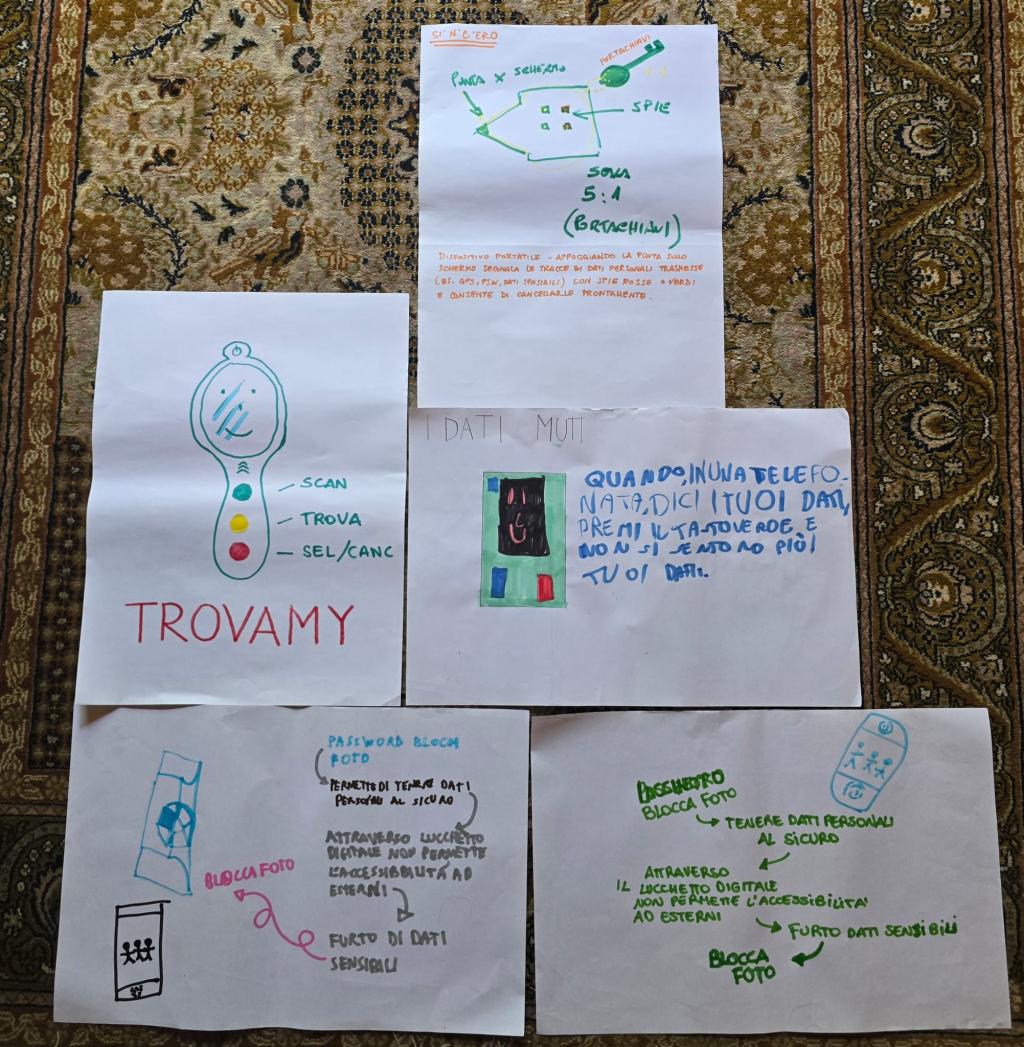
What emerged can be seen in the drawings
There is Sincero, a portable device which, when placed on a screen, detects traces of transmitted personal data (GPS, passwords, sensitive data) and flags them with red or green lights, so they can be deleted immediately. There is Trovamy, a camera that works like Google Lens in reverse: it scans your face, searches for all the photos online featuring you and shows you where they are, so you can choose what to remove. There is the Digital Spot Remover (a ring, a piercing, or glasses with an activatable tag) that erases traces of your identity whilst you are online.
There is Blocca Foto, a digital padlock that prevents external access to personal data. And there is a tool that silences you at the exact moment you are about to give away information you shouldn’t. Finally, based on the principles written on each invention card, we have built together the digital pact of the 303 Association:
- Our data is precious; we must take care of it.
- You don’t have to post everything: it’s your choice to make yourself visible.
- Our identity is unique. We are always the same person.
- We only share with those who know how to look after our data.
- To feel good, we must feel good together.
Five simple, direct sentences, written by about twenty people on an afternoon in May. The sort of things we perhaps already know, but which do us good to say out loud, together.