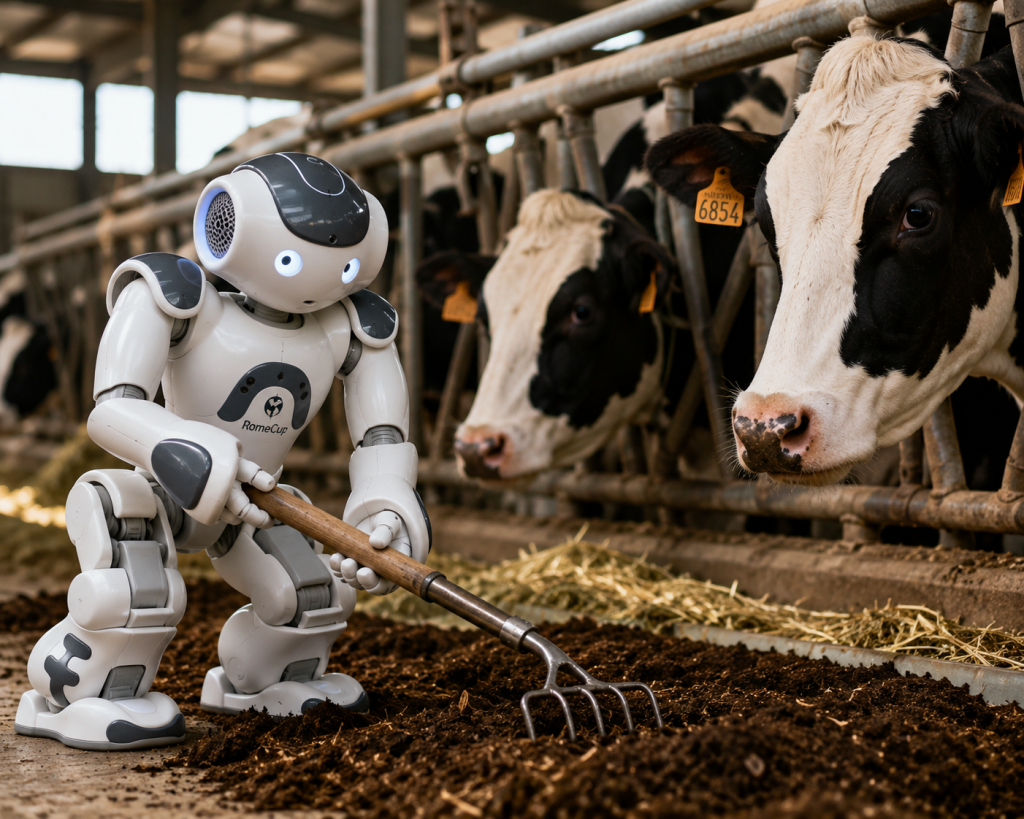

At RomeCup 2026, robotics applied to agriculture and animal husbandry becomes a tool for addressing real needs
Agriculture is the first sector chosen by the European Commission to launch a structured dialogue on the application of artificial intelligence. On 24 June, 180 experts from businesses, research institutions, agricultural organisations and public administrations discussed how to make tools already used to monitor crops and soil, forecast yields, improve safety and automate certain tasks more widespread, reliable and accessible. A clear consensus emerged from the discussion: AI must support farmers’ decisions, not replace them, and must deliver tangible value even for the smallest farms [see First structured sectoral dialogue on the application of AI. Agriculture leads the way].
It is against this backdrop that the projects in the Agrobot category of the RomeCup 2026 take on their significance. Whilst Europe seeks to accelerate the adoption of smart solutions in the agri-food sector, students are already experimenting with robotics, sensor technology and artificial intelligence to address real-world needs: personalising animal feed, monitoring greenhouses and crops, analysing product quality and improving the precision of sowing. Technology is thus finding its way into fields, greenhouses and livestock farms not as an abstract exercise, but as a tool to improve resource management, support human labour and make production processes more sustainable.
The category involved four collaborations between secondary schools and universities, confirming RomeCup as a widespread laboratory for innovation and educational partnership. The prototypes presented also demonstrate a principle shared with the European context: for innovation to be adopted, it must be reliable, understandable, accessible and designed with the needs of its users in mind.
The first prize was won by Diet Bot, developed by the Bertrand Russell High School in Cles (Trento) with the support of the Campus Bio-Medico University of Rome. The prototype is a smart robotic feeder designed for animal husbandry, capable of recognising individual animals and calculating, in real time via an artificial intelligence model, the most suitable diet based on weight and biometric data. It is a solution that translates a very practical need into a technological solution: personalising nutrition, improving animal welfare and optimising farm management. At RomeCup, the project was recognised precisely for this ability to combine functionality, impact and practical application.
Alongside the winning project, the category also featured other interesting experiments. The Giorgi Woolf High School in Rome, again with the support of the Campus Bio-Medico University of Rome, presented Smart Greenhouse Controller, a solution for advanced greenhouse management. The system is based on a control board featuring an ESP32 microcontroller and a dedicated web platform that enables real-time monitoring and management of environmental parameters. In this case, robotics works in tandem with sensors, remote control and digital interfaces to make the greenhouse a more observable, adjustable and efficient space.
The value of the Agrobot category is also evident from the variety of solutions developed and the network of collaborations established during the academic year. The Enrico Fermi Technical and Technological Institute in Francavilla Fontana (Brindisi), in collaboration with the University of Pisa, presented Mister Farm, a smart analyser based on artificial intelligence and multispectral spectroscopy.
The device reconstructs the optical signature of materials to monitor nutrients and water characteristics, assess the most suitable light for crop growth, and analyse the quality of products such as oil, fruit and organic food, whilst also detecting the possible presence of undeclared substances. The data collected by the sensors is processed and displayed in real time, providing a compact and accessible tool for precision agriculture.
TheIstituto Omnicomprensivo Antonio Giordano in Venafro (Isernia), with the support of theCampus Bio-Medico University of Rome, has developed FarmyBot, a tracked robot designed to automate sowing. Programmed using Arduino and powered by a solar panel, the prototype moves across the ground, drills a hole, deposits the seed, covers it and activates the irrigation system, repeating the cycle autonomously. The solution is designed primarily for small-scale farmers, urban allotments, greenhouses and cooperatives, and aims to reduce labour time and seed wastage, with a view to integrating artificial intelligence systems for soil recognition in the future.
From crop analysis to automated sowing, these projects demonstrate just how broad the scope of agricultural robotics is. Collaboration between schools and universities enables students to engage with real-world needs, experiment with different technologies and understand that innovation requires a combination of technical skills, contextual knowledge and a focus on sustainability.
More generally, the ‘Agrobot’ category provides a very concrete illustration of educational robotics: not machines designed to amaze, but systems designed to measure, adapt, control and prevent. Whether it is a question of feeding animals more effectively or monitoring a greenhouse remotely, the aim is not to automate everything, but to enhance the ability to observe and intervene in a more precise, sustainable and informed manner.
This is also one of the strongest messages of the RomeCup 2026 creative contests: the quality of a project is not measured solely by its technical complexity, but by its ability to be useful, accessible, original and socially relevant. In the Agrobot category, this idea takes shape in prototypes that address the local area, work, sustainability and the future of skills, demonstrating how innovation can arise from the convergence of technical expertise and practical responsibility. The projects in the creative competitions were assessed precisely on the basis of originality, functionality, usability, accessibility, sustainability and social impact.