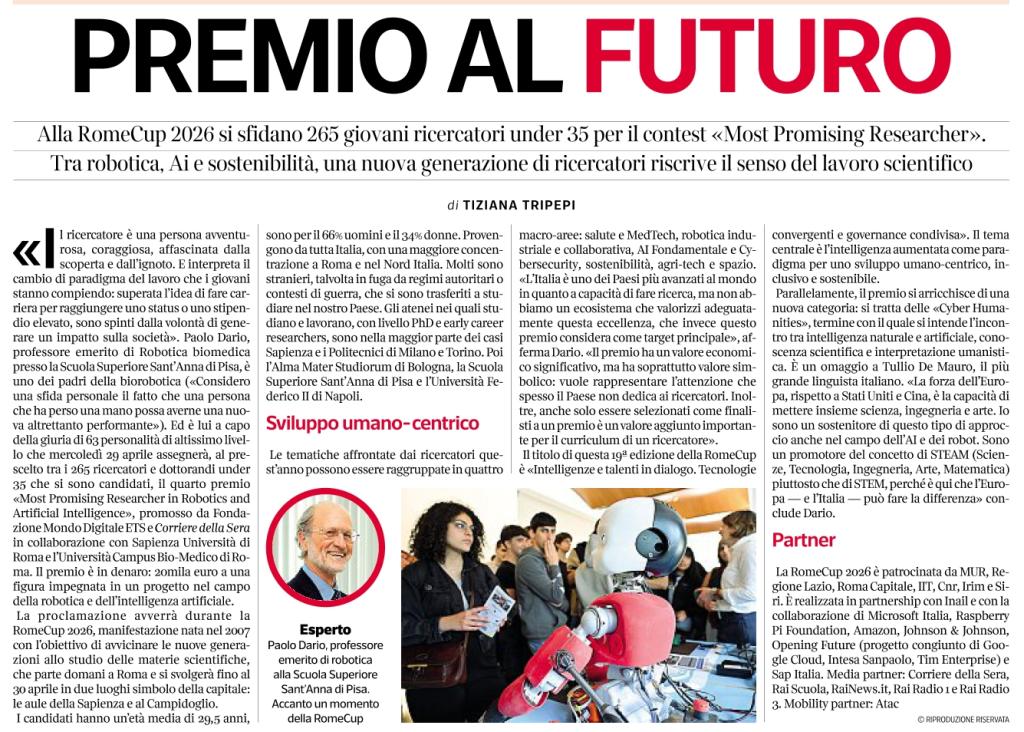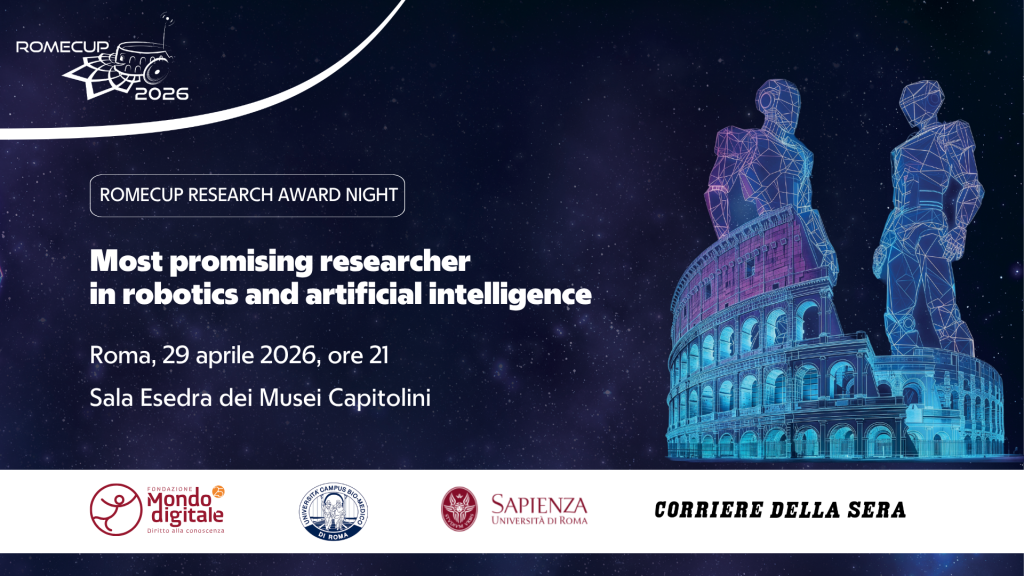

The award ceremony will take place on Wednesday 29 in the Esedra Hall of the Capitoline Museums
Selected from 265 candidates from across Italy, the 13 finalists for the Most Promising Researcher in Robotics and Artificial Intelligence award represent the cream of a new generation of scientists. Assessed by a jury of 63 experts chaired by Professor Paolo Dario, these young talents are competing for a prize of €20,000 that recognises scientific rigour, innovation and social impact [see the news item Research Award: a large and qualified jury at work].
The figures for the final: towards equity
Analysis of the 13 selected profiles reveals significant data, which in part diverges from the general distribution of the 265 candidates:
- Gender: there is an almost perfect gender balance among the finalists, with 7 men (54%) and 6 women (46%). This is a significant improvement compared to the initial pool, where women accounted for just 34%.
- Geography of excellence: Tuscany dominates the field with 6 finalists (from the Sant’Anna School of Advanced Studies, the University of Pisa and the University of Florence), followed by Lombardy (Milan) and Lazio (Rome) with 2 representatives each. Other researchers come from leading universities in Trento, Verona and Genoa.
- Major research areas: over 60% of the projects (8 out of 13) focus on the Health & MedTech sector, confirming health as the prime area for robotic innovation.
The frontiers of research: between humanism and technology
The finalists’ work redefines the relationship between man and machine through pioneering solutions:
- Digital diagnostics and biomarkers: Alessandra Sorrentino (UniFi) is developing social robots capable of interpreting the dynamics of human interactions as ‘behavioural biomarkers’ for the early monitoring of neurodegenerative diseases. Meanwhile, Angela Sorriento (Sant’Anna) is using AI to standardise ultrasound, making it an objective technique that can also be used remotely.
- Surgery and bionics: Andrea Mariani (Soundsafe Care) proposes a completely non-invasive form of cancer surgery using focused ultrasound. In the field of prosthetics, Erik Gasparini and Marta Gherardini (Sant’Anna) present radical innovations: from the low-cost LimbMATE device to the revolutionary myokinetic interface based on implanted magnets.
- Inclusion and well-being: Micol Spitale (Polimi) and Alice Nardelli (UniGe) are focusing on social robotics to support, respectively, groups of people with cognitive disabilities and intercultural education in multicultural schools. Christian Tamantini (CNR) is designing adaptive robotic coaching systems for physical rehabilitation and mental health.
- AI reliability and transparency: Massimiliano Mancini (UniTn) and Enrico Marchesini (UniVr) are working to make AI safe and reliable, studying algorithms capable of ‘unlearning’ sensitive data (Right to be forgotten) and verifiable learning models for critical infrastructure.
- Environment and open knowledge: Simone Tani (UniPi) brings AI autonomy to underwater drones for monitoring seabeds and Posidonia meadows, whilst Matteo Russo (Tor Vergata) proposes an open-source digital library of mechanical components to democratise hardware design.
- Clinical support: Matilde Buattini (SFU Milan) explores the integration of generative AI as a “third agent” in cognitive-behavioural psychotherapy.
Inspiring stories: research as a mission
Personal motivations reveal a vision of science as a tool for redemption and responsibility. Some have transformed the pain of family illness into a stimulus for new treatments, whilst others recall the Assisi earthquake as the driving force behind developing technology people can trust in emergencies. Several finalists emphasise the importance of interdisciplinary collaboration and navigating non-linear paths, reminding young researchers that “you don’t need to start out confident; you need to keep going even when you’re not”.
The final ceremony, which will celebrate these talents under the symbolic gaze of the statue of Marcus Aurelius in the Sala Esedra of the Capitoline Museums, represents the culmination of a journey that places humanity, its rights and its languages at the heart of the technological revolution. The award has received the prestigious medal of the President of the Republic.