
The Innovation Gym’s fab lab is collaborating with Musiba
A museum built by children, in the school where Alberto Manzi once taught, is now embracing digital fabrication technologies. The fab lab of the Palestra dell’Innovazione at the Fondazione Mondo Digitale is collaborating with Musiba, the ‘Alberto Manzi’ Children’s Museum of Natural Sciences, housed in the Fratelli Bandiera school of the Montessori Maria Clotilde Pini comprehensive school, to create a number of educational exhibits using 3D printing.
Musiba originated from a school workshop run over the years by a Roman teacher, known as Maestra Titti, and was transformed into a museum thanks to a curatorial project by Sapienza University of Rome, at the instigation of Rome’s 2nd Municipality. The museum was inaugurated in the renovated wing of the Fratelli Bandiera school, in Piazza Ruggero di Sicilia, in the presence of the Mayor of Rome, Roberto Gualtieri, and the Rector of Sapienza, Antonella Polimeni.
The exhibition features scientific projects created by children of yesterday and today: cardboard universes, solar systems made of modelling clay, mammoths constructed from recycled materials, and papier-mâché landscapes, alongside natural history specimens such as fossils, ancient tree trunks, a mammoth tusk and entomological collections. A special museum, designed entirely with children in mind, where curiosity becomes knowledge and learning is built through experience.
The collaboration with the Fondazione Mondo Digitale’s FabLab adds a new dimension to the project: that of digital fabrication. Through 3D printing, shapes, structures and artefacts can be reproduced, manipulated, observed up close and used as tools to make science education more tangible. Technology does not replace hands-on experience, but enhances it: it helps transform an idea into an object, a model into an educational tool, and a curiosity into a journey of discovery.
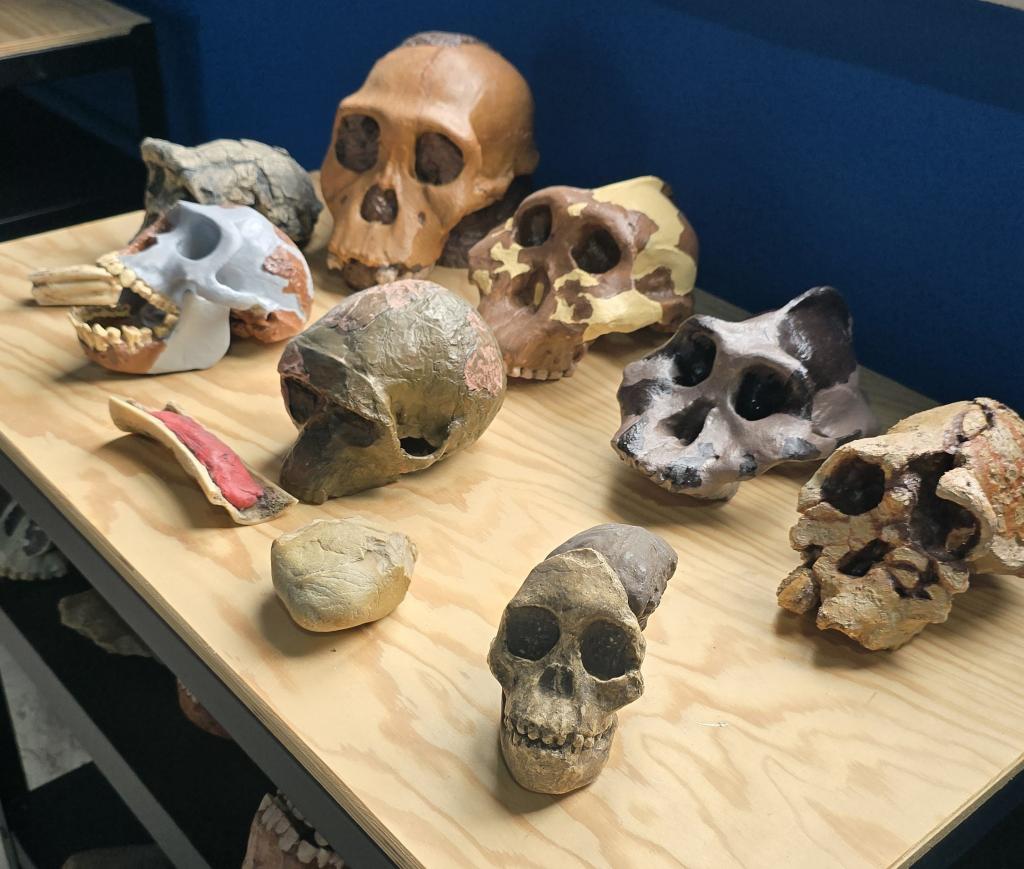
The museum is divided into five sections dedicated to space, human palaeontology, geology, the theory of evolution and palaeontology. In this context, the 3D-printed artefacts created by the FabLab become part of a learning environment that combines science, creativity and experimentation, highlighting Alberto Manzi’s educational legacy and his vision of school as a place of research, participation and shared growth.
“With the Palestra dell’Innovazione’s Fab Lab, we are working to ensure that technologies become tools for knowledge, not just technical skills. In this project, 3D printing helps to give shape to science and make learning more tangible, accessible and participatory. It is a collaboration that we feel is very much in line with our mission: to put innovation, education and creativity at the service of the community,” explains Daniele Vigo. "In particular, using the Fab Lab’s machines, we helped cut out the signage and the logo, and print the skulls.
For the Fondazione Mondo Digitale, the collaboration with Musiba confirms the role of the Palestra dell’Innovazione as a space open to the city, where schools, teachers, students and the community can experiment with emerging technologies in a useful, inclusive and learning-oriented way.
In this case, 3D printing is not just a technical skill to be acquired, but a language for exploring reality, building models, understanding complex phenomena and bringing knowledge closer to children.
Musiba is open to visitors every second Sunday of the month, from 9am to 1pm, at the Fratelli Bandiera school, in Piazza Ruggero di Sicilia 2, Rome.