The first day, as recounted by Onelia Onorati
The art of Loris Cecchini, the natural heritage of the Brera Botanical Garden and a community of people who, over the past twenty-five years, have helped shape the history of the Fondazione Mondo Digitale. The first instalment of Knowledge that Connects, which opened on 15 October in Milan, brought together representatives from institutions, academia, business and partner organisations, alongside lecturers, students and members of the public. Against the backdrop of the artist’s works, the relationships forged over time by the Foundation were given tangible expression through encounters, dialogues and new connections.
Onelia Onorati takes us through the story of the opening afternoon, bringing to life the key figures, the encounters and the highlights of an event that wove together scientific research, art and social innovation.
Journalists, lecturers, students, managers and members of the public: many joined the team from the Fondazione Mondo Digitale for the first stage of ‘Conoscenza che connette’ (‘Knowledge that Connects’), the cultural project marking the organisation’s 25th anniversary, held at the Brera Botanical Garden and in the former Church of San Carpoforo from 15 to 18 October 2026.
The afternoon of 15 October was entirely dedicated to the art installation, with the opening ceremony presided over by the Vice-Chancellor of the University of Milan Marina Brambilla, the President of the Brera Academy of Fine Arts Marco Galateri di Genola, and the Fondazione Mondo Digitale. This was followed by an in-depth discussion on the cultural significance of the project with Andrea Pinotti, lecturer in Aesthetics at the University of Milan, Maurizio Guerri, lecturer at the Academy, the curator Valentino Catricalà and the artist Loris Cecchini. The Rector emphasised the role of the Botanical Garden as a meeting place for knowledge and a forum for dialogue between disciplines and society, highlighting its connection with Milan’s cultural identity, forged over more than two centuries of history.
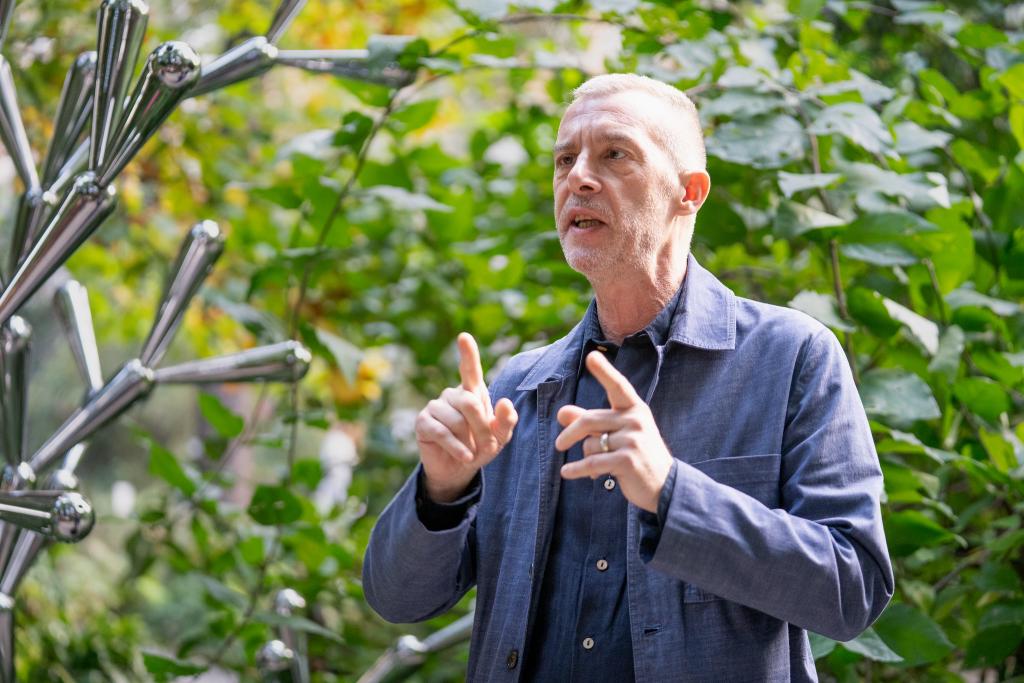
Subsequently, Cecchini took on the role of guide, leading the large group on a walk to discover his four works. The artist explained how nature is a powerful source of inspiration for him, and how his work is characterised by modularity. It is precisely this approach that allows the individual parts to exist in relation to the whole.
Visitors were thus able to rediscover the botanical heritage of the garden, with its century-old ginkgo biloba trees, and imagine novel associations between natural and artistic elements – leaves, seeds and branches. Several representatives from Milan’s universities, which have forged close ties with the Foundation over the years, joined the walk: from the Politecnico di Milano, the Vice-Chancellor, Donatella Sciuto, and Professor Paolo Rocco. Representing the University of Milan were, amongst others, Silvia Salini, lecturer in Statistics, and Pierluigi Perri, associate professor of ‘Cyber Security, Privacy and the Protection of Sensitive Data’. Representing the University of Bergamo was Cristina Roscia, lecturer in the Department of Engineering and Sciences.
There were several participants from the City of Milan, a partner in the Remid@ project (REndere Milano Inclusiva e Digitale – Making Milan Inclusive and Digital), set up to tackle the digital divide and support citizens in the informed use of technology: Gaia Romani, Councillor for Neighbourhood Decentralisation and Participation, and Francesco Pizzorni, a member of staff at the Department of Civic and General Services, Participation and Decentralisation. Also present from the partner organisations were Furio Gramatica, Director of Innovation and Development, and Anna Cavallini, Director of the Department of Neuropsychiatry and Developmental Rehabilitation at the Don Gnocchi Foundation. The group collaborated with the Fondazione Mondo Digitale on the development of ‘Pathway Companion’, an intelligent tutoring platform designed to support carers of young people with special educational needs. Also raising a glass with us were Silvia Colombo, Head of External Communication & Corporate Social Responsibility at ING (a partner in the Job Digital Lab), Claudia Casavola, regional representative for Digital Education and AI at the Lombardy Regional School Office (USR Lombardia), Barbara Cominelli, Executive Chairman of Spindox, and Roberta Cocco, an expert in digital transformation and women’s empowerment. Many teachers and trainers were in attendance, including the headteacher of the Leone XIII Institute in Milan, Letizia Cova.