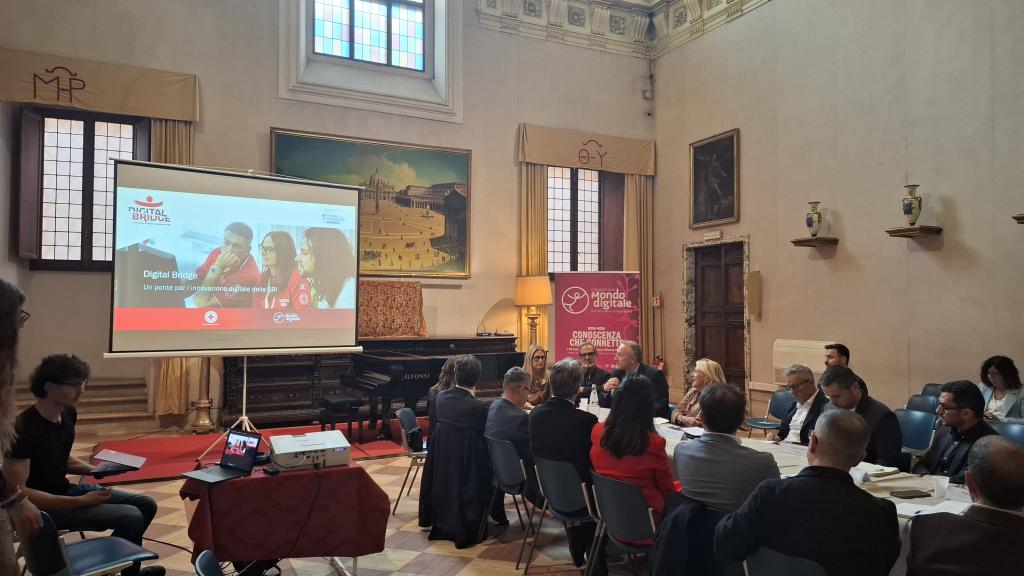
Initial findings from research into the Italian Red Cross’s digital transformation presented in Rome
Digital skills have increased by 29 per cent, with even more significant progress in artificial intelligence and problem-solving skills (+43 per cent). These are the initial findings of research into the digital transformation of the Italian Red Cross, which offers an interesting perspective for the entire third sector: understanding how investment in people’s skills can translate into organisational innovation, more effective services and greater capacity for inclusion.
The findings were presented yesterday, 21 October, by Massimiliano Geoli, national secretary of the Italian Red Cross, during the conference The Social Economy in the Digital Age, organised by the Fondazione Mondo Digitale ETS as part of its 25th-anniversary celebrations, in collaboration with the Fondazione Terzjus.
At the heart of the research is Digital Bridge, the project led by the Italian Red Cross, in partnership with the Fondazione Mondo Digitale ETS, and selected and supported by the Fund for the Digital Republic – Social Enterprise, as part of the Social Digital call for proposals. This initiative offers the opportunity to observe at close quarters how investment in digital skills and artificial intelligence can support the evolution of a major third-sector organisation.
The figures behind a transformation
The pilot scheme involves 1,124 volunteers and staff, active across the Italian Red Cross’s network of over 700 branches, comprising 106 training sessions, 18 teaching modules and 15 months of activities. Analysis of a longitudinal sample of 716 participants yields significant results:
- +29% in the overall digital skills index, rising from 1.50 to 1.94 on a scale of 0 to 3
- +43% in problem-solving and artificial intelligence skills, the area showing the greatest relative growth
- from 0.94 to 1.82 in self-assessment of the ability to use effective instructions (prompts) to improve productivity with AI
- 94 per cent satisfaction with the training experience
- 89 per cent of participants consider the skills acquired to be immediately useful in their work
- 90 per cent report greater confidence in tackling the organisation’s technological challenges.
A particularly interesting finding concerns the reduction in initial skill gaps: it is precisely those with the lowest initial skills who have made the greatest progress. This is an important insight for digital inclusion policies, as it suggests that accessible and differentiated learning pathways can help reduce inequalities even within organisations.
From individual skills to collective value
In his speech, Massimiliano Geoli highlighted the Italian Red Cross’s decision to invest in training as a strategic lever for the organisation’s development. “There are many technological opportunities, but they require people with the skills to manage them; otherwise, those opportunities become obstacles and, instead of bridging the gaps, we widen them.”
This is precisely the challenge facing Digital Bridge: to make technologies accessible and useful to people in a wide variety of roles, from organisational management to community-based activities, from communication to local services. But the value of training, particularly in the third sector, is also measured by its ability to transform skills into collective benefits. “Achieving improvement means having a greater impact on the efficiency and productivity of our staff. And in the third sector, productivity means delivering more services with the same resources: it means reaching more vulnerable people,” explained Geoli.
This perspective directly links digital transformation to organisations’ social mission: making better use of available resources, strengthening collaboration and improving the capacity to intervene in communities.
Research that looks beyond training
The strategic value of the Digital Bridge case also lies in the opportunity to link three fundamental dimensions: digital skills, human capital and social inclusion. The project evaluation already draws on a wealth of information gathered through initial and final questionnaires, satisfaction surveys and analyses of training outcomes. The research broadens this perspective by proposing to examine digital transformation across multiple levels: individual, organisational and social. The results presented document the growth in skills and confidence in using technology. The next step is to understand to what extent these gains translate into lasting changes in working practices, in collaboration between volunteers and staff, in the efficiency of processes and, ultimately, in the quality and accessibility of services. As Geoli emphasised, “If that skill remains solely with the individual and is not passed on to the organisation, we have only done half the job”. This is also a key issue from the perspective of impact assessment: how do we move from individual learning to organisational change? And how do we recognise the contribution of this change to the creation of social value?
The integration of quantitative data, qualitative insights and the observation of organisational practices can help answer these questions, distinguishing the immediate outcomes of training from the effects that develop over time.
A laboratory for the social economy
The scale of the Italian Red Cross, the variety of roles involved and the geographical reach of its network make Digital Bridge a particularly significant case study for the third sector. The aim is to contribute to the development of a replicable analytical model, capable of helping other organisations to understand and measure the effects of investments in digital skills and artificial intelligence. The research thus forms part of the discussion launched during the Rome conference on the role of the digital transition in the first National Plan for the Social Economy. This discussion centres on the need to recognise digital technology as a cross-cutting dimension of the sector’s development, to invest in human capital, and to equip organisations with the tools to assess the social benefits of innovation.
From this perspective, the collaboration between the Italian Red Cross and the Mondo Digitale Foundation also takes on a significance that extends beyond the individual project. It is an alliance combining educational expertise, innovative capacity and an understanding of social needs, which enables the testing of solutions and the generation of evidence beneficial to the entire sector.
“These projects, which involve collaboration between various third-sector organisations, demonstrate that the network is not just talk: the network is made up of concrete actions that then lead to tangible initiatives for our communities on the ground,” concluded Geoli.
This, ultimately, is the challenge that Digital Bridge presents to the social economy: to transform people’s skills into a shared resource, capable of strengthening organisations and multiplying opportunities for inclusion.