
At RomeCup 2026, fourteen projects are transforming robotics, artificial intelligence and sensor technology into tools for health, independence and wellbeing
Where does artificial intelligence really work in healthcare? Not always where it is most visible. Whilst public debate focuses on diagnostic algorithms and the most advanced applications, many of the initiatives already in operation within European healthcare systems concern less spectacular but decisive steps: guiding a citizen, organising a service, anticipating a need, reducing waiting times, and linking information and professionals. It is a quiet transformation. Artificial intelligence creates value when it manages to integrate into the actual processes of care, without adding complexity and without undermining the relationships on which care is based. An effective solution is not merely one that works from a technical standpoint, but one that successfully integrates into everyday practices, professional roles and the responsibilities of both carers and those receiving care.
The article published by the magazine Agenda Digitale on 24 July details applications already in use within Italian healthcare organisations: chatbots for accessing services, predictive models for bed availability and admissions, algorithms for operating theatre scheduling, and process mining tools for mapping care pathways [see Artificial intelligence in healthcare: where it’s really working].
TheWorld Health Organisation’s 2026 report on the state of preparedness of the European Union’s healthcare systems also calls for a view that goes beyond individual applications. Adoption is growing – 74 per cent of countries already use AI for assisted diagnosis and 63 per cent for conversational services – but the impact depends on data quality, expertise, governance, human supervision and the ability to integrate these tools into the organisation of care.
It is in the light of this transformation that the fourteen finalist projects of HealthBot – the competition organised by the Il Futuro della Cura programme at RomeCup 2026 (29 April) – take on particular significance. The students did not work on large hospital systems, nor could they have done so. They observed care in its everyday context, identifying the points where it can become fragile: a missed dose of medication, an interrupted exercise, an unrecognised obstacle, a posture maintained for too long, an emotional signal that cannot be put into words. The prototypes thus reflect the very evolution currently taking place within healthcare systems: the shift from artificial intelligence as a standalone service to artificial intelligence as a component of a process, subject to human objectives, limits and responsibilities.
A robot to support rehabilitation
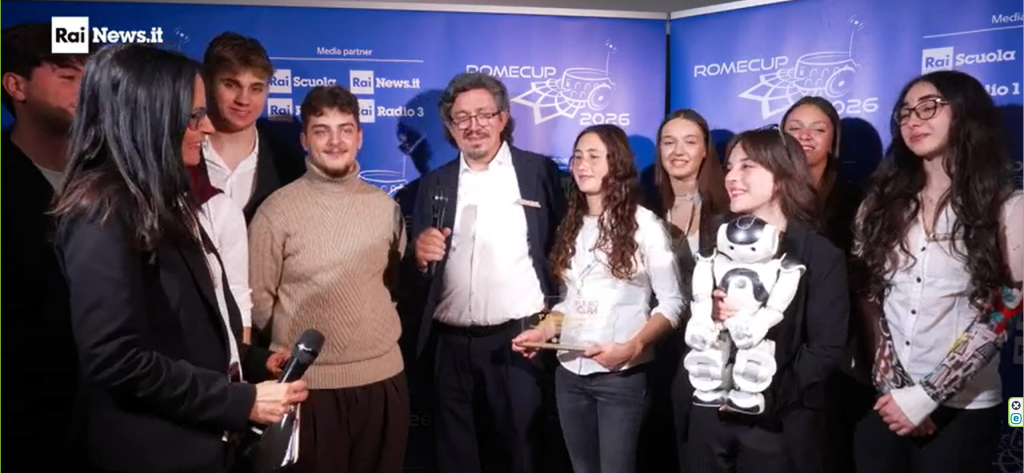
First prize was awarded to the Nao Physiotherapist, developed by the F-ISIObot team at the Ettore Majorana Scientific High School in Pozzuoli (Naples), in collaboration with the University of Naples Federico II. The project uses the Nao humanoid robot to assist with physiotherapy exercises for the upper limbs.
The physiotherapist can configure movements, angles and repetitions; the patient grasps the robot’s wrists, whilst the robot guides the execution and records the session data. The system also features a personal profile and user recognition, enabling the rehabilitation programme to be tailored to the individual. The value of this solution also lies in its continuity. Rehabilitation requires repeated exercises, motivation and consistency. The robot can make the activity more engaging and support the work carried out with the physiotherapist, even at home, without replacing their expertise. For the team, the victory also represented recognition of their perseverance. After taking part the previous year without securing a podium place, the students continued to work on the project. “This feeling of coming first is unique,” said Mario, the team leader. “For us, it means never giving up: with the right ambitions, you can aim for the very best.”
Also in the field of rehabilitation is the MRC Arm Exoskeleton, developed by the Guglielmo Marconi Institute in Nocera Inferiore (Salerno). It is a motorised exoskeleton for the upper limb, produced using 3D printing and controlled by electromyographic signals detected on the forearm. When the sensors detect the voluntary intention to move, a servomotor assists the flexion of the elbow. The system is designed both for functional recovery and to reduce physical strain in work settings. In both cases, the technology intervenes without taking away the person’s initiative: it accompanies the movement, supports it and makes it more accessible.
When movement means independence
Third place went to the smart wheelchair from the Enrico Fermi Institute in Bibbiena (Arezzo). The Mecanum wheels allow lateral and diagonal movement, as well as turning on the spot, increasing manoeuvrability in complex domestic environments and confined spaces. The wheelchair also incorporates sensors to detect gas, flames, flooding, obstacles and changes in light levels. In the event of danger, it can trigger local interventions, halt movement or send alerts to pre-set contacts via Arduino Cloud. It also features a medicine drawer, which can be programmed to open at a set time. “Our hard work has paid off,” explained Filippo, the team’s spokesperson. “This wheelchair makes a huge contribution to the comfort and safety of people with disabilities.” The project demonstrates how much independence often depends on seemingly minor movements: approaching a table, passing through a doorway, or changing direction without complex manoeuvres. Small movements that can have a profound impact on everyday freedom.
Two projects addressed the issue of mobility for blind and visually impaired people.
Second place went to Sense Core, a team from the Vito Volterra scientific high school in Ciampino (Rome), with Cernens, a wearable glove fitted with a Time-of-Flight laser sensor. The device detects the distance and position of obstacles and provides feedback via vibration motors. It is designed as a discreet tool that can be integrated into everyday movements, featuring an emergency function and potential extensions for navigation. The students also took the social aspect of the aid into account. Some people may feel uncomfortable using highly visible aids, fearing judgement or forms of stigmatisation.
The glove does not necessarily replace the white cane or guide dog, but it expands the available options and gives the user greater freedom of choice.
RoboVision, created by two students from the Enrico Fermi technical college in Francavilla Fontana (Brindisi), instead modifies the traditional cane, transforming it into a smart device. Ultrasonic sensors detect obstacles to the side and overhead, whilst a camera with computer vision capabilities recognises pedestrian crossings and provides voice guidance. A safety system alerts staff to any falls and enables the user’s location to be pinpointed. Both projects share the same focus: not merely to design a technologically advanced object, but to understand how the aid is actually used in urban, domestic and social settings.
Treatment: from prescription to intake
Four finalists tackled the issue of treatment adherence – that is, the ability to follow medication instructions correctly and consistently.
Pillonix, from the Antonio Giordano Comprehensive Institute in Venafro (Isernia), is a mobile robot programmed using Arduino. It moves along pre-set domestic routes using a line-following sensor and carries a weekly pill organiser. It can be activated by voice command, announces the day and time, and travels to the user to deliver the medication. The prototype was built using recycled materials, rechargeable batteries and solar panels.
MediBox, from the Vito Volterra High School, is an Arduino-controlled automatic dispenser. A 3D-printed carousel organises the doses, whilst a vacuum pump, a valve and a servomotor enable the pill to be retrieved and released. The device is programmable via Bluetooth and can send notifications regarding the dispensing status.
The smart alarm clock, developed by the Giuseppe Peano Scientific High School in Rome under the name Pilltime-Bot, uses visual and audible signals to remind users to take their medication. A display shows the prescribed medicine, whilst a button allows the user to confirm that they have received the alert. The project is designed primarily for older people and those with cognitive difficulties, aiming to reduce the memory burden and anxiety associated with managing complex treatments.
Keryx Kairos Chiron, designed by the Stanislao Cannizzaro Scientific High School in Rome, broadens the focus from the device itself to the entire care ecosystem. The platform connects patients, carers, doctors, specialists and pharmacies. The software component communicates with an IoT robot for the distribution of medicines: the carer prepares the doses, the device makes them available at set times and records any anomalies or missed confirmations. The students approached the project using design thinking, starting with the ‘invisible burden’ borne by those who care for a vulnerable person on a daily basis. The project demonstrates that care is not limited to a single device: it takes shape through the interaction between the patient, the carer, the doctor, the pharmacy, data, procedures and tools. The effectiveness of the solution depends on the quality of these connections.
The four prototypes tackle the same critical challenge: the gap between a prescribed treatment and its practical integration into daily life. The problem is not merely a matter of remembering the time, but also involves understanding, monitoring, reassurance and the ability to involve family members and professionals when necessary.
Recognising a change before an emergency arises
Among the most innovative proposals is rPPG, or Marconi Health Assistant, developed by Guglielmo Marconi in Nocera Inferiore. The system takes the form of a smart mirror. Using remote photoplethysmography, it analyses the subtle colour changes in the face associated with blood flow, estimating heart rate, heart rate variability and other indicators. Computer vision monitors skin tone, the sclera and facial expressions, whilst the microphone can detect breathing patterns, coughs and changes in the voice. The results are compared over time against the individual’s baseline and can generate reports and alerts. The idea is to integrate monitoring into an object and an action that are already part of daily life: looking in the mirror. Monitoring thus becomes less intrusive and does not require the user to wear, recharge or constantly activate a device. The project also raises important questions regarding data validation, the protection of health information and the distinction between screening and diagnosis. The crucial step is not merely to measure a parameter, but to understand its significance, assess its reliability and incorporate it into an observation and decision-making process that remains human. It is precisely this comparison between opportunities and limitations that makes the educational experience particularly meaningful.
Bringing wellbeing into the working day
Also from ITI Marconi comes the Office Well-Being Digital Assistant, designed to prevent physical and mental discomfort in office environments. The system combines a sensor-equipped headband and a webcam. It monitors ECG, heart rate, respiration, heart rate variability and posture, analysing the data in real time. When it detects stress, fatigue or an incorrect posture maintained for too long, it suggests breathing exercises, micro-stretching, postural corrections or short breaks. The assistant does not intervene when the problem has already become serious, but attempts to identify, at an early stage, habits and conditions that may lead to discomfort. Digital medicine thus enters an everyday setting, far from the hospital, and supports the individual during their daily activities.
Three different ways of listening to distress
Mental health was one of the areas most extensively explored by the finalists from the Don Milani-Da Vinci high school in Bari, with three distinct projects.
MindEcho is a smart emotional diary. The user describes their day and assigns it a rating; the system analyses the emotional tone, records positive experiences and builds up a personal memory over time. When it detects a difficult moment, it retrieves episodes and resources that have previously helped the person overcome similar situations. The project therefore uses the user’s history as material to strengthen awareness and confidence.
MindBot is a chatbot that combines free-form text with data relating to sleep, physical activity, time spent online and social media use. Using heuristic rules, machine learning and natural language generation, it identifies possible signs of stress, overload or low energy and provides personalised suggestions. The system is accessible via a web browser and places particular emphasis on data privacy.
Controdepressione, on the other hand, focuses on the technical, economic and ethical feasibility of a chatbot. The prototype uses Python and open-source libraries, runs locally and analyses the content and tone of messages. The students assessed its costs, sustainability, privacy, transparency and risks, making it clear that the tool is for educational purposes only; it is not diagnostic and does not replace psychological therapy.
Fourteen projects, one common question
HealthBot does not merely reward technical complexity. It asks students to view healthcare as a system comprising people, relationships, data, environments, skills and tools. A solution may be innovative yet difficult to use; it may collect a great deal of information without presenting it in an understandable way; it may automate a function whilst, at the same time, creating new risks or dependencies. That is why the most interesting projects do not merely demonstrate what technology is capable of. They seek to understand where to integrate it, which needs to address, who to involve, which responsibilities to uphold and which consequences to consider.
At RomeCup 2026, the future of healthcare did not take the form of an all-powerful machine. It appeared in the often-overlooked steps that make everyday health possible: remembering to take a medicine, sticking to an exercise routine, crossing a road, moving around a room, correcting one’s posture, noticing a change, finding the words to ask for support. It is in these steps that innovation becomes truly useful: when people, practices and technologies manage to strike a balance within the complexity of healthcare.