
In Milan, coding becomes storytelling with young primary school programmers
There is a deep connection between the order of a mythological tale and the precision of a line of code, a subtle thread that links the logic of thought to the magic of creation. On the occasion of National STEM Week (4-11 February) and on the eve of World Safer Internet Day (10 February), we celebrated an extraordinary achievement that transformed a school hall into a laboratory of innovation and creativity. This success is part of the national Coding Girls & Women programme, an initiative that is growing and consolidating this year thanks to funding from the Ministry of Labour and Social Policies (for the year 2024, pursuant to Article 72 of Legislative Decree No. 117/2017), allowing us to bring digital culture to primary schools as well.
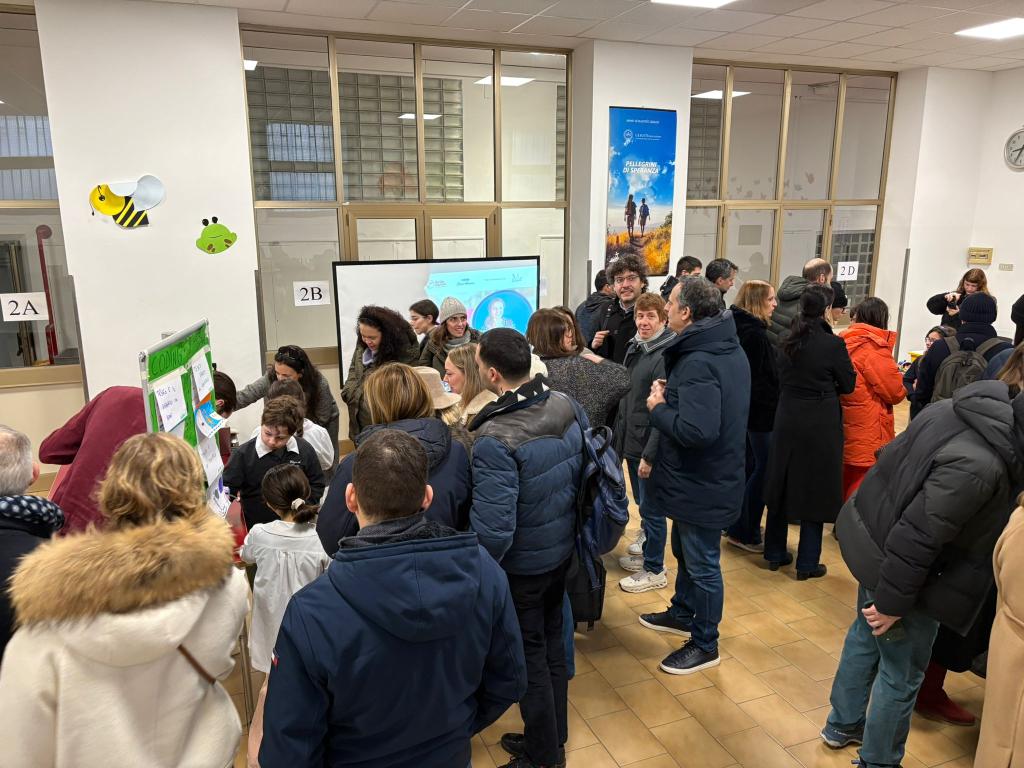
Yesterday morning in Milan, at the Istituto Leone XIII, after introductory greetings from the headmistress of the primary school, who opened the doors to this experimental journey, the heart of the event saw the boys and girls take centre stage, ready to explain how technology can become a tool for giving shape to age-old ideas. Guided by trainer Tommaso Di Pietro, the young protagonists retraced a journey that lasted three meetings, where the keyword was “order”: they learned that a robot can only work if it receives precise and sequential instructions, just as in a story where each event must follow the other to make sense.
It all started away from the screens, with an approach inspired by theatre and team building: before touching the Lego bricks, the classes immersed themselves in the story of Theseus and the Minotaur, understanding that practising without a goal makes everything more difficult, also because, as Anita from class 3A reminded us this morning, “before instructing machines, it is essential to put your thoughts and things to do in order, as well as working in harmony with your group”. From colourful posters depicting the details of the myth, from the colour of Theseus' clothes to the shape of the traps in the labyrinth, we moved on to the challenge of physical construction with Lego Spike kits. Each group brought a fragment of the legend to life: Theseus' ship emitting the sound of waves and stopping on the golden sand, the gate of the labyrinth opening with a terrible echo, the Minotaur striking rhythmic blows until it is defeated, and the essential thread of Ariadne, a robot capable of following a red trail to find its way out.
During this morning's presentation event, in front of the excited eyes of many parents, the children illustrated the work they had done, highlighting how each automation was the result of a collective effort. Among the most significant results of the course was the ability to collaborate to resolve minor programming errors, transforming difficulties into opportunities for discussion. This experience with the primary school, as part of the Coding Girls & Women programme, demonstrates once again how valuable it is to promote STEAM disciplines, emphasising the importance of the “A” for Arts: by integrating different disciplines - in this specific case, history, mythology, art, technology and coding - the training course goes beyond the concept of “educational exercise” to become a model of digital education; an interdisciplinary approach that inevitably and fortunately leads to the creation of something unique.
“The coding workshop that has just ended, as part of the Coding Girls & Women programme at Leone XIII school with Lego Spike kits, was an intense and revealing experience. Although it was my first time with children of this age and with only three sessions available, the response from the classes was exceptional. The main challenge was managing the perception of the tool: the temptation to see the kits as mere 'toys” was strong. After the initial settling-in period, I decided to focus on a keyword agreed with the children: order. Together, we discovered that approaching programming requires method and that creativity, in order to work in coding, must move along safe tracks. The children were very good at understanding that they were not just playing, but building logic.
The result? Expectations were exceeded and the experiment was a complete success. Looking ahead, one more lesson would be the icing on the cake to better take care of the final details, but this experience remains invaluable for the next iterations of the project," commented Tommaso, trainer at Fondazione Mondo Digitale and Superforma, at the end of the course.
The story is by Elisabetta Gramatica, project officer