
When digital art becomes a measurable value. Even socially
Today, art is increasingly recognised as a strategic asset capable of generating economic, social and organisational value. The recent report Corporate Cultural & Art Assets for Sustainable Impact by Deloitte, together with the new framework developed by the Institute for Transformative Innovation & Research at the University of Pavia with Deloitte Private, Arte Generali and Banca Generali, speaks for itself: collections, artistic projects, corporate museums and cultural initiatives can become concrete levers in ESG strategies. Yet only a small proportion of European companies systematically measure this value. Art is widespread, but rarely integrated in a structured way into governance models.
In Italy, the presence of corporate cultural assets is among the highest in Europe. The challenge today is no longer “having” art, but measuring its impact, translating the intangible into shared value.
A trajectory that started long ago
In this scenario, the path taken by the Fondazione Mondo Digitale appears surprisingly relevant. From the Media Art Festival to artist residencies, from light artists to collaborations with businesses, digital art has been an infrastructure of social innovation for us. Not an isolated event, but a permanent laboratory capable of:
- activating creative skills in young people;
- building bridges between culture and business;
- transforming technology into accessible language;
- strengthening the link between organisations and territories.
Today, the debate focuses on measuring cultural assets. But the intuition that art and development are interconnected has been part of our DNA for over a decade.
2026: art tells the story of the third sector
On the road to our 25th anniversary, this vision takes on a new form. An immersive video installation will come to life in Rome and Milan in collaboration with Unidata. In other cities, the digital spaces of Urban Vision will be involved, transforming urban space into a narrative surface.
The work of the selected artist (whose name we are not revealing at this time) explores the boundary between human vision and computational vision: natural landscapes are transformed into abstract compositions generated by algorithmic processes. It is an investigation into how we observe and interpret reality today, in an age dominated by data and artificial intelligence. But it is also a metaphor. As in the artist's layered digital landscapes, the history of the Foundation has also been built up through successive overlays of experiences, experiments and models. Curator Valentino Catricalà sees in the work a process of recurrence and continuous transformation: a dynamic that ideally dialogues with 25 years of education, inclusion and social innovation.
Art, ESG and the third sector
The Deloitte report highlights a crucial point: a single cultural asset can generate simultaneous benefits for businesses, communities and the local area. It is the “one-to-many” logic. In the third sector, this principle is even more evident. An art installation is not just a cultural event:
- it strengthens an organisation's identity;
- it activates communities;
- it generates public dialogue;
- it has an impact on reputation;
- it creates relational value in local areas.
If businesses today are required to report cultural value in their sustainability reports, social organisations can, and must, also recognise art as an integral part of their impact strategy.
From the past to the future
This is the meaning of the column 25 years ago, today. It is not simply a nostalgic exercise, but a reinterpretation of insights that today find a new language: governance, metrics, ESG, frameworks.
Digital art is a lens through which to understand complexity. And in 2026, between Rome and Milan, we will recount how the third sector can be a fully-fledged protagonist of contemporary life.
An example of transformative art
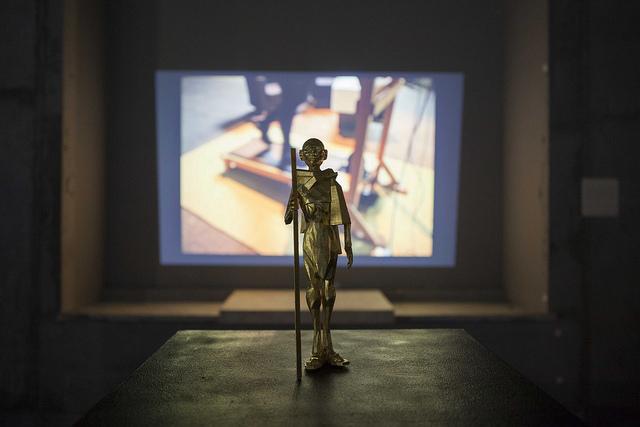
In 2017, at the Media Art Festival, Joseph DeLappe described his digital Salt March as an experience that had changed him: ‘I started with a performance piece, but I was intrinsically transformed.’ For 26 days, he walked on a treadmill, reconstructing, in physical and virtual parallel, the 240 miles travelled by Gandhi in 1930. Each real step advanced his avatar on Second Life. That work is a concrete example of what we now call transformative art. It is not simply an exhibition, but a process that intertwines memory, technology, participation and awareness. It is an experience capable of generating cultural, educational and social impact. In light of the European debate on the measurement of Corporate Cultural & Art Assets in ESG strategies, experiences such as this show how art can become a strategic lever: it activates communities, produces learning, strengthens identity and creates shared value.