
RomeCup 2026. An original workshop as part of the event “Digital and Generations. Building Well-being Together”
It’s 2040. Scrolling through social media at night is a thing of the past, ‘likes’ are consigned to the history books, and cyberbullying is a distant memory. Thanks to something someone invented. But what? That is the question faced by the hundred or so Roman secondary school pupils who took part in the workshop ‘The Museum of Objects from the Future’, as part of the event Digital and Generations: Building Wellbeing Together at the RomeCup 2026 (28–30 April).
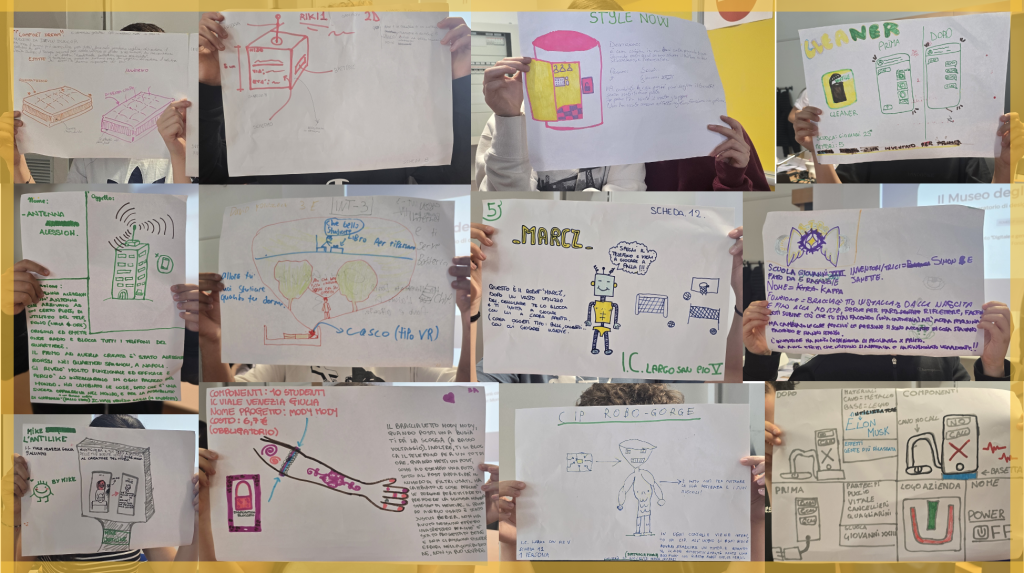
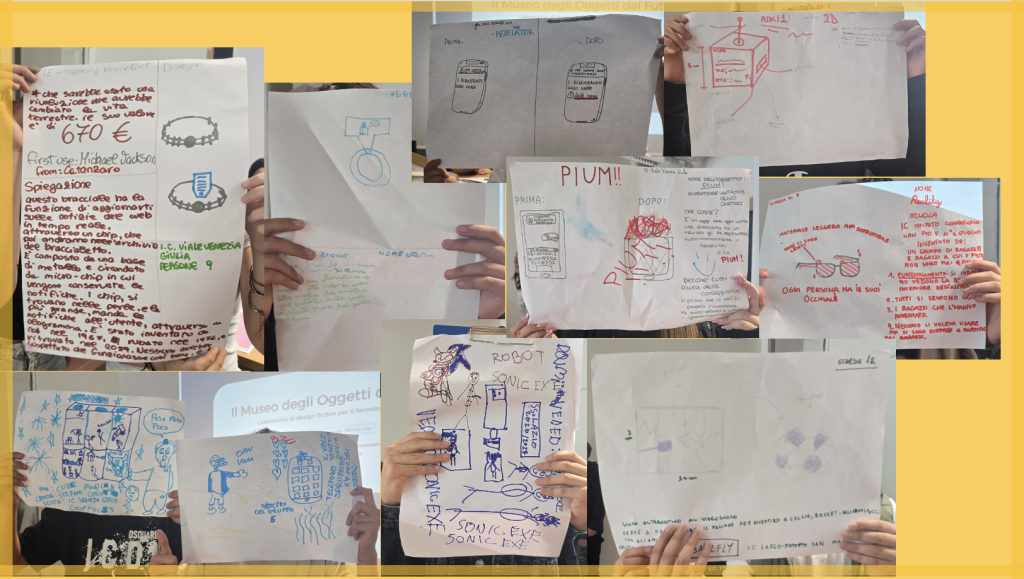
The mechanism is simple. Each group received a scenario sheet: a short text set in the near future, where a problem linked to digital wellbeing has been solved. The sheet does not say how. The pupils’ task was to invent the object that made that change possible: to draw it on an A3 sheet, give it a name, and write a description as if it were on display in a museum.
No mobile phones, no tablets. Just paper, felt-tip pens and imagination. A completely analogue workshop, inspired by design fiction, an approach used in international contexts, from the Near Future Laboratory to MoMA in New York, to make possible futures tangible and reflect on them in the present.
Fifteen groups, fifteen different scenarios. Each scenario built around a specific theme of digital wellbeing: from compulsive scrolling to privacy, from online hate to artificial intelligence, from body filters to digital loneliness. The students had 40 minutes to work, then each group held up their sheet and some presented their invention to the class.
The aim
In this workshop, digital wellbeing enters through the door of creativity. The students aren’t listening to a lecture on what to do or what to avoid with technology: they’re designing how they’d like it to work. And without the themes being explicitly stated in a lecture, they emerge on their own.
The results
Inclusion through drawing. The visual format allowed everyone to participate. A Chinese boy with language difficulties was able to express himself through drawing and contribute to his group’s work. Students with physical and mental disabilities actively participated in creating and presenting the objects. A teacher said she was very pleased that her students had had a space to express themselves in front of the class, even if the drawing wasn’t perfect: what mattered was being there, sharing their idea.
A space to express oneself, even when it’s difficult. A teacher approached us at the end of the workshop to hand over a girl’s drawing. The object she had invented was a somewhat violent solution, which the girl had not wanted to present. But the teacher was pleased: the girl had found a space to let out her anger, and that was already an achievement.
Creativity and fun. The children had fun. They worked with enthusiasm, exchanged ideas within their groups, drew, discussed and laughed. The workshop worked because it felt like a serious game, with clear rules and open space for imagination.
All analogue, all human. In an event dedicated to digital technology, the workshop was screen-free: paper, felt-tip pens and conversation. Technology was the theme, not the tool.
The objects of the Museum of the Future
Here are the twenty-two objects invented by the groups. Some are poetic, others ironic, and a few are decidedly radical. All reveal how the young people see their relationship with the digital world and how they would like it to be different.
- Comfort Dream. A bed that entices you to sleep so deeply and snugly that the very idea of opening your mobile phone becomes impossible. Technology fades away in the face of the pleasure of a good night’s sleep!
- Mike the Antilike. An app that hides likes from all social media. No one knows how many they’ve received, no one counts them; only the content remains.
- Night-Time Art Projector. A projector installed on the bedroom ceiling which, when you lie down, projects works of art. An invitation to look up, rather than at the screen.
- Mody Mody. A bracelet that detects when you post something fake online. The consequence? A small shock… just enough to convince you not to do it again!
- Sonic Robot. A robot inspired by Sonic, the video game character, who accompanies you in your daily life and helps you improve your relationship with your mobile phone. Designed by a young man with a disability, who has transformed his favourite hero into an ally for digital wellbeing.
- INT-3 Helmet. A helmet that lets you study whilst you sleep. Sleep becomes more precious – and useful – than the screen.
- Magic Cube. A cube with special powers that replaces screen time with real-life experiences.
- Phone with a spray nozzle. A phone with a built-in water spray nozzle. If you scroll for too long, it sprays you in the face. Simple and effective.
- Alessio Antenna. An antenna positioned on every building in the neighbourhood. Once your four hours of daily usage have elapsed, it automatically deactivates your mobile phone. The solution is collective: it applies to everyone, at the same time.
- ALTERN Bracelet. A bracelet that alerts you when you’re using your mobile phone too much. A reminder to wear on your wrist at all times.
- PIUM! App An app with a simple mechanism: every time someone posts an insult online, their phone explodes. A drastic solution, a crystal-clear message.
- Memory Bracelet. A bracelet that updates web news in real time, right on your wrist. Your phone stays in your pocket.
- Reality Glasses. Special glasses that let you see people’s inner beauty. The wearer no longer sees outward appearances. Everyone feels equal.
- Robot Marcz. A robot that locks your phone after excessive use and invites you to do something together: play football, go out, get moving. The solution to digital addiction is a playmate.
- Robot George Chip. A microchip that can be installed in any video game. When you’ve been playing for too long, it shuts the game down and persuades you to stop, by hook or by crook…
- Ball Fly. A ball that encompasses all sports: football, basketball, volleyball and more. The alternative to a mobile phone is an object you can throw, kick or pass around.
- Riky Box 1. A box connected to a satellite. It can trace in real time who is writing what on the web, immediately unmasking anyone hiding behind anonymity to spread hate.
- Power Off. A device that switches everything off. A single gesture, a button, and the screen goes dark.
- Style Now. A booth that chooses your outfit for you, without making you feel out of place. No more comparing yourself to others on social media: you leave the house knowing you look just right.
- The Relevator. An instant mechanism that analyses any news story and tells you straight away whether it’s true or false.
- Kappa Bracelet. A bracelet that’s with you from birth. It grows with you. It encourages you to reflect on your behaviour and become a better person, day by day.
- Cleaner. An app that cleans up your inbox, filtering out useless and dangerous messages. What arrives on your phone is only what’s worth reading.
If we look at the list of items, one thing stands out: almost all the young people have invented something that protects them from excess. Something that helps them to stop, to switch off, to make different choices. In short, they know exactly where the problem lies and when you give them paper and pens, they come up with the solution.
And imagining is the first step towards making things happen.