
From incubators to artificial intelligence, an online journey between Italy and Mozambiqu
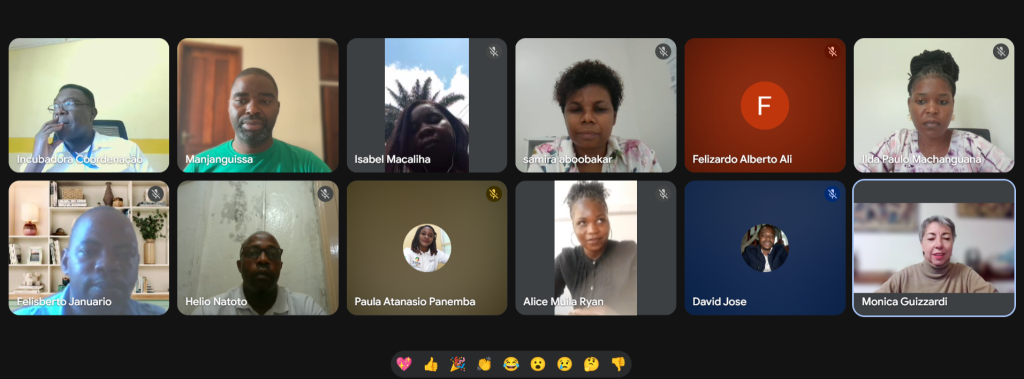
Since last February, a video link has connected Italy and Mozambique every week. On one side is Monica Guizzardi, a trainer appointed by Fondazione Mondo Digitale. On the other are the technicians from the ICT incubators, the project coordinators and the start-ups that are actively building a part of Mozambique’s digital economy.
There are two training programmes, both part of initiatives funded by the Italian Agency for Development Cooperation (AICS, Maputo office): the ICT Employment Generation project (led by the Centre for Information and Education on Development) and the Digital Embrace project (led by Humanity and Inclusion). The first involves the four members of the IEJI incubator and representatives of the eight incubated start-ups, with sessions accommodating up to 20 participants; the second is aimed at the eight technicians from the Inage technology incubator in Nampula, supported by representatives from CIES and INEP and start-up representatives, for a group of around 17 people.
From idea to practice: what is learned
The modules cover progressive topics: from the fundamentals of incubation to digital collaboration tools with Google Workspace, from creating content for Tech Hub communications to the informed and critical use of artificial intelligence for daily productivity, right through to specialised digital tools for start-up management. The common thread is an approach that combines theory (30 per cent) and practice (70 per cent): each session produces something tangible, such as a map of the local ecosystem, an editorial calendar, a set of reusable templates, etc., which participants can apply directly to their work.
Remote training, adapting to reality
Working online across different time zones and with varying infrastructure requires constant flexibility. Connectivity in Mozambique is often unreliable and not all participants have a personal computer: sessions are therefore scheduled at times when groups can connect from Tech Hub locations, where the connection is more reliable. Attendance varies from session to session, and to keep engagement high, each session is built around practical exercises based on real-world cases: participants don’t just listen, they create and experiment together.
Halfway through
The modules on the fundamentals of incubation and digital content creation have already been completed. Between April and June, modules on Google Workspace, sessions on artificial intelligence and specialised digital tools for start-ups will take place, with a final session – for the ICT Jobs project – dedicated to the sustainability of incubators. Each module is followed by a follow-up activity a few weeks later, to consolidate what has been learnt and support its practical application in daily work.
A programme still in progress, but already capable of demonstrating what training can achieve when it is truly designed for those receiving it.