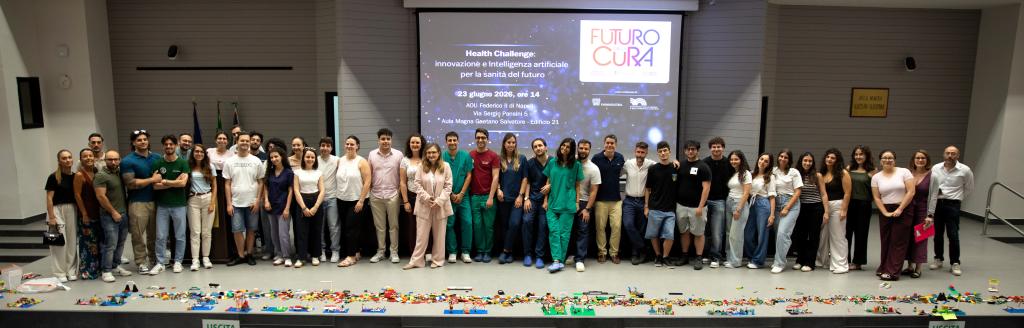

Naples hosts the first Health Challenge of “Il Futuro della Cura”
Professionals, academics and students gathered at Federico II to co-design the healthcare of tomorrow, combining algorithms, human expertise and Lego® bricks.
Last Tuesday, in the Gaetano Salvatore lecture theatre of the School of Medicine and Surgery at the Federico II University of Naples, the first regional stage of the Health Challenge took place – a collaborative innovation workshop forming part of the Il Futuro della Cura project. The initiative, organised by Johnson & Johnson and Microsoft Italia and promoted by the Fondazione Mondo Digitale, aims to strengthen the digital skills of healthcare professionals, with a particular focus on the informed and critical integration of artificial intelligence into clinical and care pathways.
The day began with opening remarks from Franca Di Meglio, Coordinator of the Postgraduate Schools in Healthcare at the Federico II University of Naples, Giovanni Riccardi, Analytics & Operational Excellence Lead at Johnson & Johnson Innovative Medicine Italia, Federica Rossi, Microsoft Elevate AI Skills Director at Microsoft Italia, and Mirta Michilli, Director General of the Fondazione Mondo Digitale. The speeches highlighted the value of collaboration between universities, businesses and third-sector organisations in guiding the informed adoption of artificial intelligence and supporting the development of the skills required for the healthcare system of the future.
The training session, organised by the Fondazione Mondo Digitale, offered participants an overview of the challenges and opportunities associated with the use of AI in healthcare. To open the session, Raffaele Izzo, Full Professor of Advanced Medical and Surgical Technical Sciences at the Federico II University of Naples, introduced the host institution and set out the challenge at the heart of the workshop.
Next, Giuseppe De Rosa, full professor of Pharmaceutical Technology, and Gerolama Condorelli, full professor of General Pathology at the University of Naples Federico II, explored in depth the contribution that artificial intelligence can make to pharmaceutical research and precision medicine respectively.
At the heart of the challenge lay a crucial question: how can AI improve the work of professionals and the patient experience without replacing clinical judgement and the value of human interaction? To find an answer, researchers, doctors and students worked side by side, discussing real-world challenges and devising solutions capable of combining technological innovation with quality of care.
Thinking with your hands: the Lego® Serious Play® methodology
The facilitation session and the teams’ work were led by Cecilia Stajano, community manager at Fondazione Mondo Digitale and a certified Lego® Serious Play® facilitator, who guided participants in exploring scenarios, challenges and opportunities linked to the adoption of artificial intelligence in healthcare.
Lego® Serious Play® is a facilitation approach based on the principle of ‘learning by playing’, which uses the famous bricks as genuine ‘cognitive artefacts’ to help people explore ideas, build shared meanings and develop strategies for action. According to this methodology, when we build tangible models in the real world, we simultaneously construct mental models, making complex connections and lines of reasoning visible.
The hands thus become the brain’s ‘search engine’. During the challenge, participants answered strategic questions by building three-dimensional models and using the language of metaphor to tackle complex issues, encouraging discussion and the emergence of creative and inclusive solutions.
In their own words: the interviews
At the end of the challenge, lecturers and students from Federico II University shared their views on the role of artificial intelligence in research, education and clinical practice.
“We have only recently started using artificial intelligence, but already in two main areas: research and clinical practice. In research, we have access to enormous databases and collaborate with engineers who, thanks to AI, are able to extract and analyse complex data, helping us to realise its full potential. On the clinical front, we are developing a project in which artificial intelligence listens in on the conversation between doctor and patient, supporting the formulation of a diagnosis and the summarising of the consultation. The latest development in the project even involves the Neapolitan dialect: patients speak in dialect and the AI is able to understand them and support the diagnostic process. Sometimes even for the doctor it is not easy to grasp every nuance of the patient’s account; in this sense, artificial intelligence provides a practical aid.”
Raffaele Izzo, Full Professor of Advanced Medical and Surgical Technical Sciences
“Postgraduate trainees already use it frequently to seek advice when diagnostic or therapeutic doubts arise. It is an extraordinary tool that allows for the deepening of knowledge, encourages discussion and can lighten part of the daily workload. For professionals already heavily burdened by clinical work and training, artificial intelligence can provide invaluable support.”
Franca Di Meglio, coordinator of the Healthcare Specialisation Schools
“Artificial intelligence is still underutilised compared to its true potential, but I believe it can offer a great many opportunities. It will certainly play a fundamental role in clinical practice, supporting doctors in diagnostic and therapeutic pathways. It will become an increasingly common tool in the day-to-day work of all healthcare professionals, regardless of their specialism, not only in supporting clinical decision-making but also in organising activities, both in hospitals and in the private sector. As for Lego® Serious Play®, this methodology draws on an approach that is also widely used in sports medicine: gamification, that is, the use of play to achieve educational and therapeutic objectives. Making the learning of certain concepts simpler and more engaging helps to convey them more effectively to people. In this case, it has also been useful for us doctors, who will subsequently be called upon to design and support treatment and recovery programmes.”
Aldo De Martino, a doctor specialising in Sports Medicine
“Artificial intelligence is becoming increasingly prevalent in the field of precision medicine, which aims to identify the most suitable treatment for each individual patient. Thanks to their ability to process extremely complex data, these technologies will enable us to identify the ideal treatment for a specific patient and a particular condition ever more rapidly.”
Gerolama Condorelli, full professor of General Pathology
“The opportunities are enormous, because it will be possible to significantly reduce the time needed to bring a new medicinal product to market. In particular, artificial intelligence will make it possible to reduce the number of tests and experiments required, contributing above all to a substantial reduction in in vitro trials and, even more so, in vivo trials.”
Giuseppe De Rosa, full professor of Pharmaceutical Technology
“The doctor of the future cannot limit themselves to clinical practice alone, to surgery alone or to basic sciences alone. They will need to integrate technological and engineering skills into their profession. Starting this during their university studies means developing, right from the outset, that multidisciplinary way of thinking which today is an essential prerequisite for shaping the future of healthcare. A multidisciplinary approach will enable us to have an increasingly innovative healthcare system, keeping pace with new discoveries and ever closer to the needs of the public. It means training professionals capable not only of embracing innovation, but of steering it, contributing directly to channelling it towards patient protection and the strengthening of our national healthcare system.”
Ciro Brescia, student of High-Tech Medicine and Surgery and student representative