
The winners of the fourth edition of the ‘Most Promising Researcher in Robotics and Artificial Intelligence’
From reliable machine learning to inclusive social robotics and accessible bionic prosthetics: the recipients of the RomeCup Research Award 2026 embody a new vision of scientific excellence.
At the fourth edition of the Most Promising Researcher in Robotics and Artificial Intelligence, RomeCup recognised three distinct research trajectories united by a shared vision: harnessing the power of artificial intelligence and robotics to serve people, their rights, their autonomy and their quality of life. The profiles recognised in 2026 demonstrate that scientific excellence is not limited to publications, algorithms or highly complex devices. It is also the ability to identify real needs, transform social problems into research questions, and develop reliable, accessible and responsible technologies.
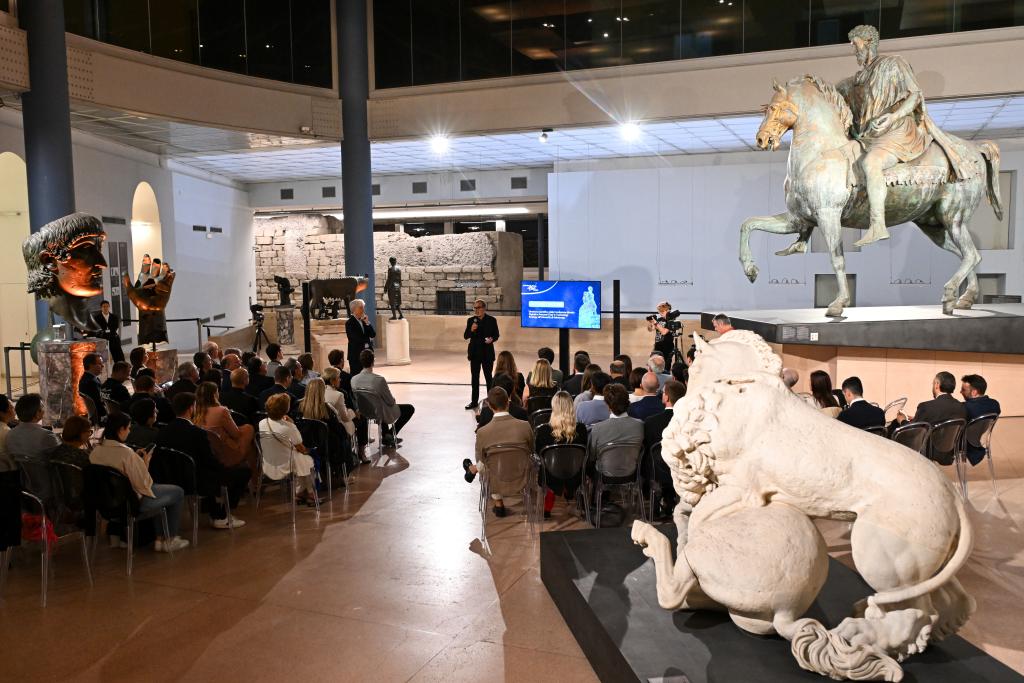
The awards ceremony took place last night in the Sala Esedra of the Capitoline Museums, on the Capitoline Hill, streamed live on Corriere.it. Moderated by Riccardo Luna, journalist and columnist for Corriere della Sera, the RomeCup Research Award Night saw the finalists of the Most Promising Researcher in Robotics & AI present their projects in a dynamic format, designed to encourage direct interaction with the jury, businesses and the public. Following opening remarks by Alfonso Molina and Paolo Dario, the evening concluded with the announcement of the winners by Mirta Michilli, Director General of the Fondazione Mondo Digitale ETS, and the presentation of the RomeCup Research Award 2026, the Digital Humanities Award “Tullio De Mauro” and an award for the best PhD student.
Massimiliano Mancini: teaching intelligent systems to learn, correct themselves and forget
Massimiliano Mancini, 34, a researcher at the University of Trento, won the Most Promising Researcher in Robotics and AI award with research addressing one of the key challenges for the future of robotics: enabling visual systems to operate in real, uncontrolled environments where conditions are constantly changing. The robots of the future, Mancini explains in his application, will not live solely in laboratories or predictable settings: they will enter homes, hospitals, factories, and complex spaces inhabited by people with diverse needs. For this reason, it will not be enough for them to be ‘powerful’: they will have to learn to adapt, recognise their own limitations, correct errors and biases, and respect users’ privacy and rights. His research focuses on computer vision systems capable of learning autonomously, adapting to new scenarios, identifying flaws in their own behaviour and, when necessary, unlearning information. This last aspect is particularly relevant to the right to be forgotten and data protection: the aim is to enable the targeted removal of sensitive information without having to retrain the entire model and without introducing new biases. His scientific career has already yielded contributions recognised within the international community, with dozens of publications in leading journals and conferences in the fields of computer vision, robotics and artificial intelligence. But the heart of his research remains applied: starting from concrete problems, identifying the assumptions that limit the use of existing technologies, and developing solutions to overcome them. His personal motivation also helps to understand the direction of his work. Mancini says he has always been drawn to puzzles and brain teasers: to the possibility that, behind something seemingly confusing, there lies a structure to be pieced back together.
For him, research is precisely this: piecing together scattered fragments to advance knowledge and generate real impact. Having grown up in Umbria, with vivid memories of the Assisi earthquake, he has focused his interest on systems capable of adapting to the unpredictability of the real world, even in emergency situations.
Micol Spitale: social robots that include, listen and adapt
Micol Spitale, 32, from the Politecnico di Milano, was awarded the special Digital Humanities Award, established in honour of Tullio De Mauro. Her research focuses on a highly sensitive topic: the use of artificial intelligence and social robotics to support people with intellectual disabilities in group settings, such as day centres, schools and supported living environments. Most assistive robotic systems, Spitale notes, are still designed for one-to-one interactions. But real life consists of groups, relationships, multiple conversations, shared attention, and the presence of carers, therapists, family members and people with different needs. Furthermore, many artificial intelligence models are trained on data relating to neurotypical populations and therefore risk failing to adequately represent the variety of behaviours, communication styles and cognitive needs of people with disabilities. His research opens up an innovative line of inquiry into group-human robot interaction, that is, the interaction between robots and groups of people. The aim is to develop socially intelligent systems capable of interacting safely, respectfully and adaptively with diverse groups, managing turn-taking, shared attention and support for shared activities. At the heart of this is the concept of inclusive AI: models capable of learning and adapting to different ways of communicating, participating and relating. The project integrates technological research, participatory co-design and validation in real-world settings. It is therefore not limited to building laboratory prototypes, but works with therapeutic and care centres to verify that the systems are accessible, respectful and consistent with the experience of those involved. The aim is to support autonomy and participation, reduce the repetitive burden on carers and therapists, and contribute to new policies for digital accessibility and the equitable integration of technologies in sensitive contexts. His career path also highlights the value of interdisciplinarity. Spitale has a background in aerospace engineering, but chose to pursue research in Information Technology to work on issues that can directly impact people’s lives. His motivation stems from the intersection of scientific curiosity and social awareness: designing technologies that do not create new barriers, but enhance participation, dignity and inclusion.
Erik Gasparini: more intuitive, accessible bionic prostheses that better meet people’s needs
Erik Gasparini, 26, a PhD student in biorobotics at the Scuola Superiore Sant’Anna in Pisa, has been recognised as the best PhD student for research that combines robotics, artificial intelligence and biomedical devices with a very concrete aim: to improve the quality of life for people with amputations. The starting point is an unresolved issue: despite technological advances, many people abandon active prostheses because they are complex to use, unintuitive or lack adequate sensory feedback. Gasparini’s work addresses this gap by developing non-invasive, bidirectional interfaces capable, on the one hand, of interpreting the user’s motor intent and, on the other, of providing useful sensory feedback. The key innovation is LimbMATE, an Italian platform for advanced prosthetic control. The device integrates AI algorithms to decode myoelectric patterns in real time, a vibrotactile module to provide feedback on actions such as grasping and releasing an object, and a lightweight, low-power, low-cost structure. Weighing just 23 grams, with a power consumption of 200 mW and component costs of around €200, LimbMATE offers a vision of technological excellence that is accessible and potentially sustainable for the healthcare system. The project has already reached an advanced level of technological maturity and has passed electronic and software safety tests in accordance with international standards for medical devices. It has also obtained ethical and ministerial approval for a comparative clinical trial in collaboration with the IRCCS Istituto Ortopedico Rizzoli, as part of the national Fit4MedRob project. Initial clinical evidence indicates improvements in activities of daily living, control of fine movements and a reduction in compensatory movements. Gasparini’s personal contribution spans all stages of the research: firmware and software development, assembly, testing, documentation for approvals, the design of original algorithms, validation with users and scientific dissemination. His motivation stems from listening to people with amputations: for them, a prosthesis that can be controlled reliably and naturally means not only regaining a function, but also regaining autonomy, independence and dignity. His personal history adds depth to this choice. Having grown up in a working-class background, with experience in study, work and volunteering, Gasparini says he has learnt to focus on the person rather than their difficulties. It is this perspective that guides his research: transforming applied robotics into a technology capable of supporting people in ‘getting back on their feet’, not only physically, but also on a human and social level.
A new concept of excellence
The research by Mancini, Spitale and Gasparini highlights three complementary directions in contemporary artificial intelligence and robotics. The first concerns trust in intelligent systems: machines capable of adapting, correcting themselves, and respecting privacy and security. The second concerns inclusion: technologies designed with and for people with diverse needs, capable of supporting participation and dignity. The third concerns care: accessible, clinically validated bionic devices built on the basis of listening to users.
In all three cases, research is not separate from society. It arises from concrete problems, spans different disciplines and seeks a measurable impact on people’s lives. This is the vision that the RomeCup Research Award brings to the centre of the debate: a science capable of shaping the future because it is capable of responsibility.