
Female Intelligence in AI: the story of Maria Pellegrino
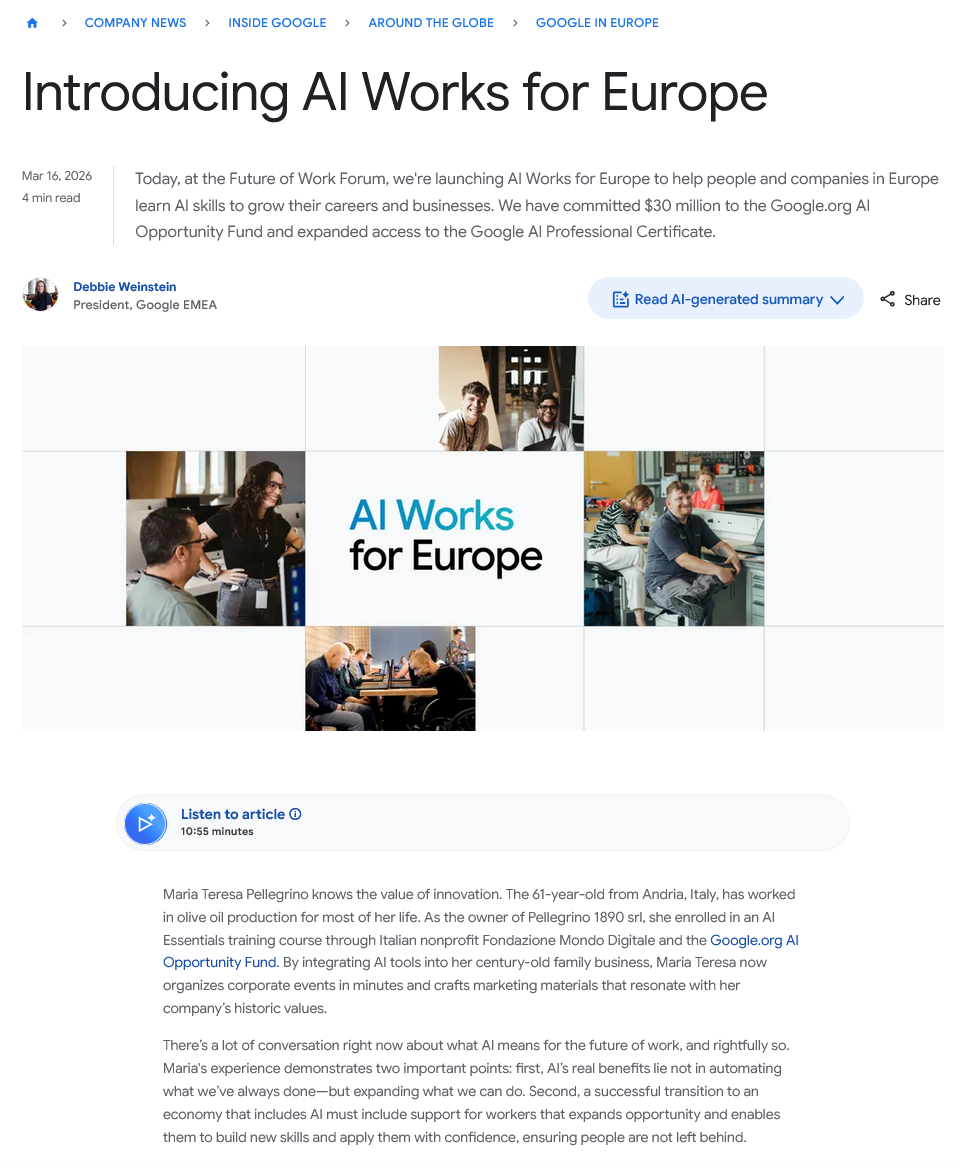
There is a thread linking the classrooms of our training projects to the major European forums where the future of work in the age of artificial intelligence is being discussed. It is a thread woven from real-life stories, journeys of growth and genuine transformations. Among these is the story of Maria Teresa Pellegrino, a key figure in the Female Intelligence project, who is now also recognised internationally. In her post published on Google’s official blog, on the occasion of the European forum Future of Work in the Age of AI (Riga, 16 March 2026), Debbie Weinstein, Google’s President for Europe, the Middle East and Africa, cites concrete examples of how artificial intelligence can generate inclusive opportunities in the world of work. Among these is Maria’s story [read the article Introducing AI Works for Europe].
When a local story becomes a European model
In the story presented by Google, Maria Pellegrino becomes a symbol of a possible transformation: that of someone who, thanks to targeted training programmes, manages to retrain and find new professional opportunities in a rapidly changing labour market. A story that the Foundation had already shared as an example of women’s empowerment, support into employment and the development of technological skills [see the news item ‘A community that helps women’]. The fact that it is being highlighted in a European context is not merely individual recognition, but signals something deeper: the educational and social experiences built up in local communities can make a concrete contribution to the global debate on artificial intelligence.
From policies to people: AI that really works
In his speech, Weinstein emphasises how artificial intelligence can be a driver of economic growth and employment, provided it is accompanied by investment in training, inclusion and skills development. It is precisely in this space that the Fondazione Mondo Digitale’s work is situated: not merely the dissemination of technologies, but the creation of empowering pathways, to enable people to choose, understand and find their way. Maria Pellegrino’s story brings this approach to life: not an abstract narrative about AI, but a concrete journey in which technology and the human dimension intertwine.
Educating about complexity, starting with stories
At a time when the debate on artificial intelligence often risks swinging between enthusiasm and fear, examples like this help refocus attention on what really matters:
- the quality of educational pathways
- the ability to support transitions
- the value of communities that sustain change
Citing Maria’s story in an international context reinforces a key message: innovation is only credible when it tangibly improves people’s lives. And it is precisely from these stories—rooted in local communities yet capable of speaking to the world—that a fairer, more inclusive and more humane future of work can emerge.