
In Foligno, the Digital Bridge project creathon with the Italian Red Cross
Digital technology becomes truly transformative when skills meet people's real needs. This is the spirit of the Digital Bridge project creathon, hosted last Saturday, 7 March, by the Italian Red Cross Regional Committee in Umbria.
The initiative, selected and supported by the Fund for the Digital Republic, aims to strengthen the digital skills of CRI volunteers and employees through upskilling and reskilling courses. In Foligno, the training turned into a real co-design experience: a creative marathon in which technology, manual skills and teamwork gave rise to concrete solutions for emergency and assistance activities.
Thinking with your hands
The creathon was based on the tinkering methodology, which encourages learning through experimentation and construction. This approach combines coding, electronics and manual creativity, transforming ideas into prototypes. As explained by Cecilia Borzese, project manager at Digital Bridge, the goal was to “bridge the gap between the digital world (coding and electronics) and manual creativity (construction and design)”.
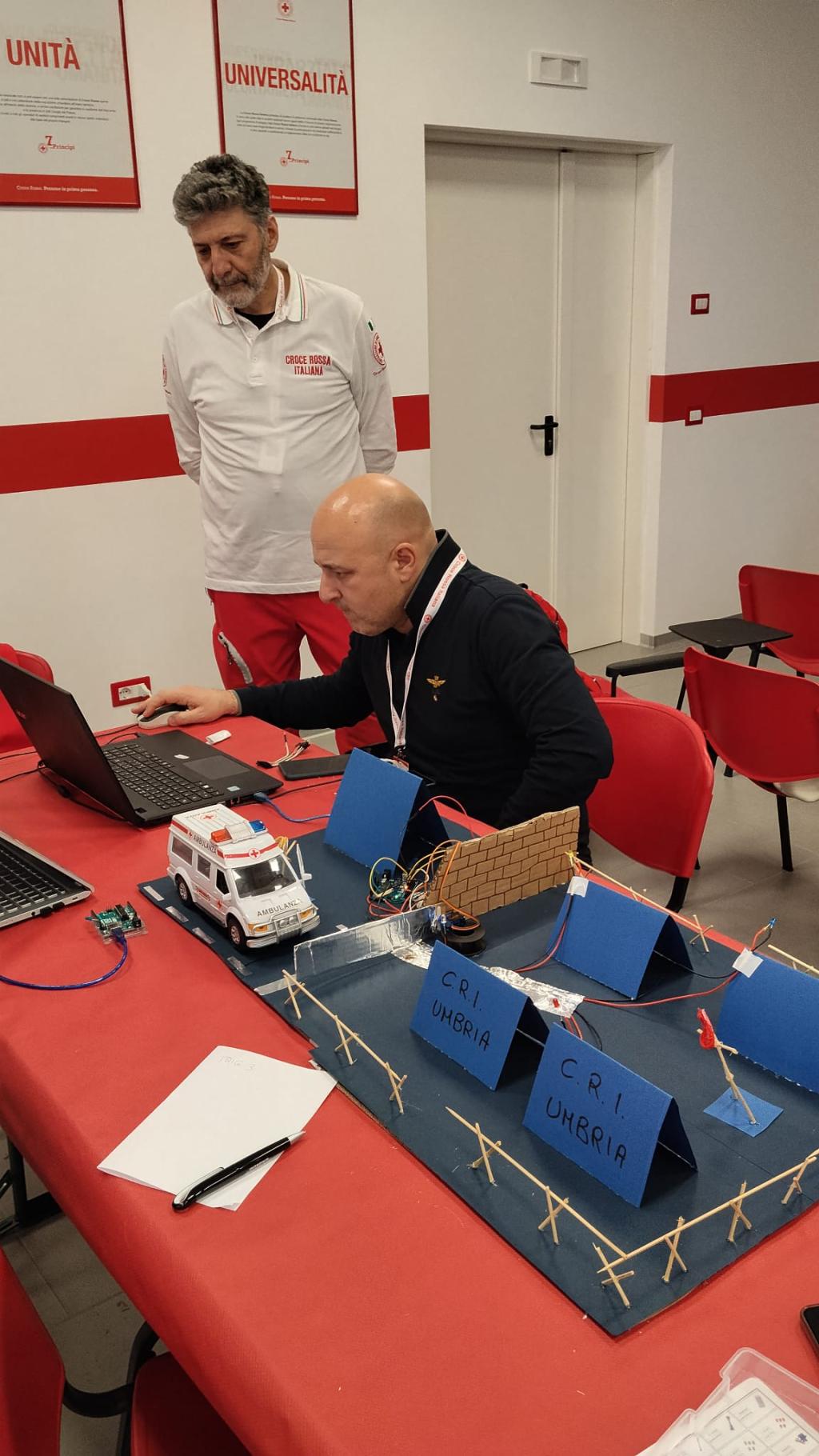
Guided by trainer Roberto Raspa, participants worked in teams using recycled materials and Arduino boards to design devices intended to improve the Red Cross's operational activities in the field. During the day, the teams developed several prototypes, all aimed at responding to concrete needs in emergency assistance and management activities.
The projects created:
- Leddino (winning project): an interactive mascot designed to welcome children in emergency areas. The prototype ‘activates when a child arrives, lights up its eyes and nose and moves’, offering a moment of reassurance in difficult contexts.
- Control Counter Access CRI: an automatic access detection system in emergency camps, designed to overcome the lack of, or slow collection of, information regarding the number of people present.
- Faro Sentinella: an automated lighting and access control system, designed to increase the safety of operational personnel and prevent intrusions.
- Door opener for people living alone: a device with sensors and remote control that allows elderly or disabled people to open the door remotely and activate emergency services if necessary.
- Emergency camp: a control barrier with an acoustic signal and integrated alarm system to safely manage the flow of vehicles and people. The project integrates an alarm signalling system, a device to quickly alert staff in the event of camp evacuation.
- Rotating bed with lifting system: a solution designed to improve the quality of life of bedridden patients and facilitate the work of operators.
In addition to the prototypes, the greatest value of the experience was the teamwork and the opportunity to experiment with new technologies in a practical way.
Andrea Limone, from the Gubbio Committee, emphasised the educational value of the day: ‘It was a really interesting and educational day [...] it allowed us to work as a team, we divided our roles well and, above all, we saw new and very interesting things such as Arduino [...] the practical experience was very useful in understanding how to use it in the field.’
For Sara Bonucci, a volunteer from the Corciano Committee, the experience was also a moment of collaboration and creativity:
‘It was a really great creative project where we were able to work as a team and each of us contributed to the project and had a lot of fun.’
At the end of the day, Cecilia Borzese described the initiative as ‘a productive and stimulating day, which allowed participants from the Umbria region to present their ideas and share their different skills in a real team effort.’